
FRENCH SCHOOL
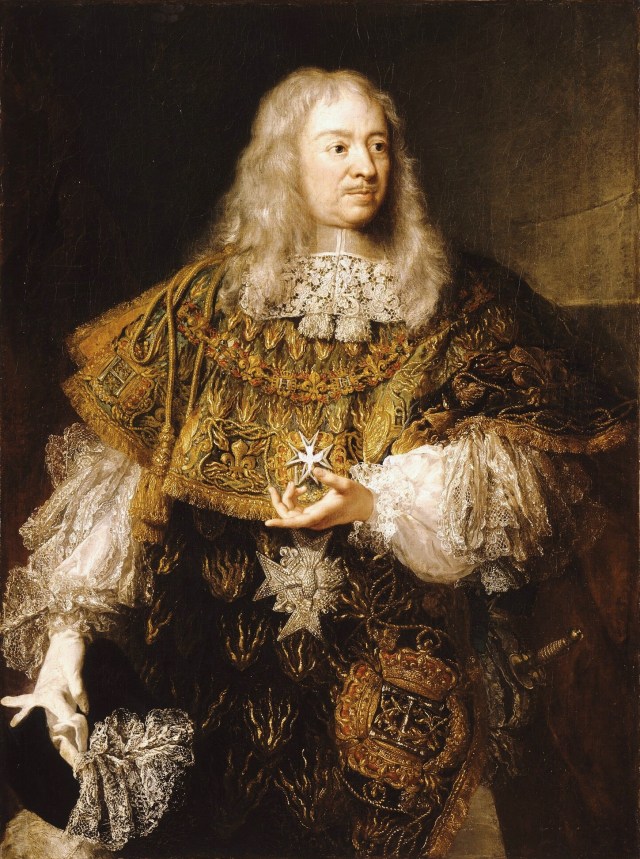
Portrait of Gabriel de Rochechouart, Duke of Mortemart
Oil on canvas (182 x 97 cm)
Chateau de Versailles
To enlarge the picture, right-click on it, then “Open in a new tab”
The sitter has been identified by comparing this portrait with a drawing in the Bibliotheque Nationale. Gabriel de Rochechuart (1600-75) began his career as a courtier at a very young age, as one of the pages to the Dauphin and future King Louis XIII. His military successes enabled him to gain access to extremely important posts, which resulted in his elevation in 1650 from Marquis to Duke of Mortemart, one of the twelve peers of the realm. Due to political strife, his title was only confirmed by the Parliament until 1663.
The affair of his daughter, Mme de Montespan, and Louis XIV earned him the post of Governor of Paris and Ile-de-France in 1669. Contemporary accounts reveal him to have been a cultivated man who was fond of life’s pleasures.
He is shown here in the attires of a Knight of the Order of the Holy Spirit. He received this honour in 1663, though his apparent age suggests that the portrait was probably painted slightly later, around 1665. The work makes and strong impression, on account of the splendid and sumptuous costume, a true masterpiece of pictorial skill. The artist has magnificently succeeded in setting the lightness of the fine lace against the heaviness of the gold-embroidered coat, with its hurried, yet perfectly mastered impasto (paint applied in thick layers)
The elegant, beautifully executed hand reminds us of the art of the great van Dyck, while the face is characterized by full lips and a piercing gaze, which bring the sitter to life and give him added presence. All this points to the fact that this painting must have been the result of several sittings, rather than the copy of an existing portrait.
Despite its brilliance and beauty, it remains anonymous. Stylistically, it is reminiscent of Claude Lefevre’s work; however, when we compare it with the almost contemporary Portrait of Colbert https://oldmasterspaintingscom.wordpress.com/2018/05/27/le-grand-colbert/ it is obviously by another hand. Other names have been suggested, including Francois de Troy (1645-1730) and Robert Levrac (1668-1752). The latter began his career too late, well after the sitter’s death. As for de Troy, he probably left Toulouse for Paris in 1662, joining Lefevre’s workshop shortly afterwards. The style of some of his portraits, such as Francois d’Orbay (Cherbourg, Musee Thomas-Henry) plus the fact that he portrayed several members of the Order of the Holy Spirit, do provide certain grounds for this attribution. However, if we accept it, we would have to assume that the Portrait of the Duke of Mortemart was the work of a very young artist, which is belied by the obvious mastery and confidence of an older, experienced painter.
 Old Masters