
CHARLES LEBRUN (1619-1690)
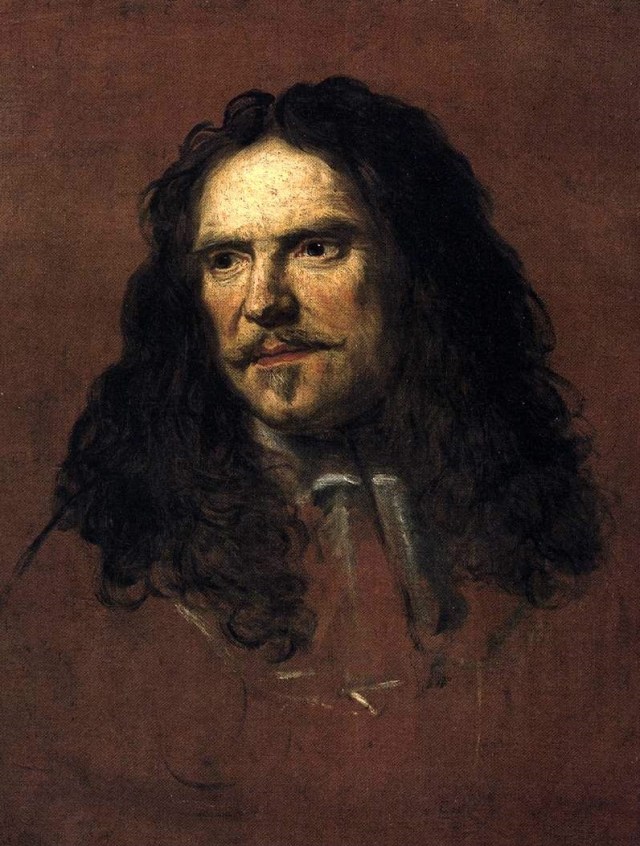
Henri de La Tour d’Auvergne, Vicomte de Turenne
Oil on canvas (67 x 52 cm)
Chateau de Versailles
To enlarge the picture, right-click on it and “Open in a new tab”
This Portrait of Turenne, with its stunning sense of presence and truth, is not a finished work, but a study for The Meeting of the Two Kings. This tapestry, which formed part of the History of the King series, illustrated the meeting between Louis XIV and Philip IV of Spain on June 16th, 1660, on the occasion of the King of France’s marriage to Maria Theresa. This union sealed the Peace of the Pyrenees, towards which Turenne had contributed with his victories over the Spanish armies.
The first tapestries in the series were woven in 1665. Lebrun, who had been appointed director of the Royal Manufacture of the Gobelins on March 8th, 1662, only began work on this project at the end of this year, which means that this study must date from around 1663-64.
Given its degree of realism, this portrait was most probably sketched during a sitting. It indicates how work at the manufacture was organized, but, above all, it gives us a precious clue as to Lebrun’s own working method. On a canvas prepared in the standard fashion, with a red-ochre ground, the outlines would be freely drawn with a brush, in lines of different colours, after which the face would gradually be modelled by shadows and accents of light, in order to give it depth and expression. Lebrun’s handling was far less free in his finished works, which were characterized by a smoother technique with softer, less distinct transitions between light and shade.
Henri de La Tour d’Auvergne, Vicomte de Turenne, often called simply Turenne (1611-1675) was a French Field Marshal and the most famous member of the illustrious La Tour d’Auverge family. His military exploits over his five-decade career earned him a reputation as one of the greatest generals of modern history. Born to a Huguenot family, Turenne began his military career at a very early age (15) serving in the Dutch army during the Eighty Years War. After returning to France in 1630, he rose to prominence during the Thirty Years War by capturing the fortress of Breisach in 1638. He was created a Marshal of France in 1643. The next year he invaded Bavaria defeating the Bavarian army after three years of campaigning.
Turenne initially supported the nobility against the King during la Fronde (1648-1653) (1) but returned to Royal service in 1651 defeating the rebellious army of the Prince of Conde on the outskirts of Paris and re-occupying the city. Turenne’s triumphs against the Spanish armies in Arras (1654) and Dunkirk (1658) led to the overruning of much of the Spanish Netherlands and brought the war with Spain to a victorious conclusion. Two years later Louis XIV made him a Marshal General of France. A supporter of the absolute monarchy, he converted to Catholicism in 1668.
In 1672 the French invaded the Dutch Republic and Turenne conquered the country up to Amsterdam. In their desperation, the Dutch destroyed the dams and flooded the country forcing the French to retire. In 1673 Turenne invaded the Holy Roman Empire forcing the Elector of Brandenburg to leave the anti-French coalition. Faced with the loss of Alsace to superior Allied forces, Turenne crowned his career with a series of victories that drove the Imperials out of Alsace. He was killed at the battle of Salzbach in 1675
(1) “La Fronde” is the name given in France to a series of combats that took place between 1648 and 1653. Some historians consider it a civil war, but I believe is too grand a name for a series of riots and combats. French historians tend to consider it (quite rightly in my opinion) as a difficult time of civil unrest. Here is a brief outline of it:
https://www.britannica.com/event/The-Fronde
 Old Masters