
PHILIPPE DE CHAMPAIGNE (1602-1674)
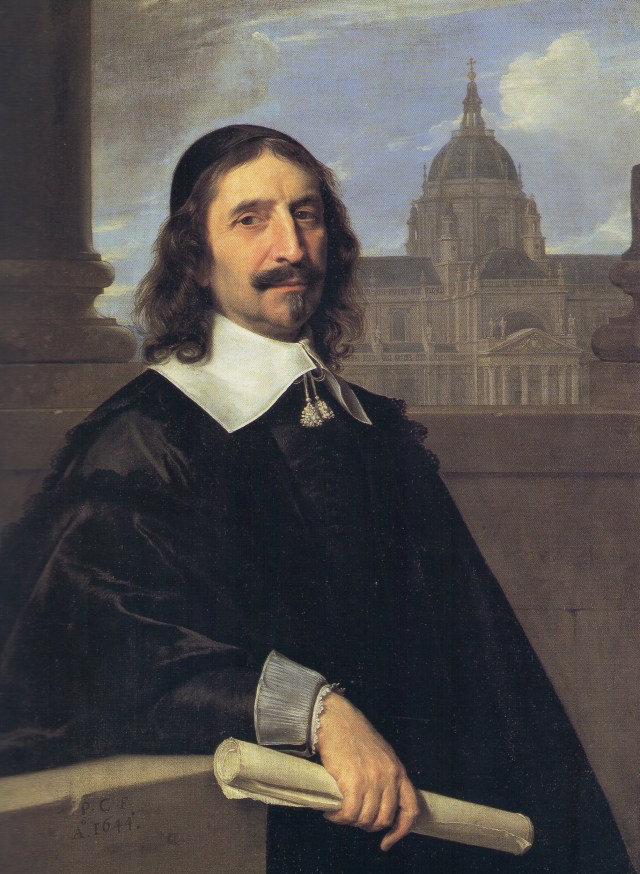
Portrait of Jacques Lemercier (1644)
Oil on canvas (97 x 75 cm)
Chateau de Versailles
Following a visit to Rome in 1607, Jacques Lemercier (1585-1654) rapidly became one of the most reputed architects in Paris. It was not long before Richelieu engaged him, entrusting him with his main building projects, the most notable of these being the Palais Cardinal (1629), the Chateau de Richelieu (1631), the Chateau de Rueil (after 1633), and above all the rebuilding of the Sorbonne, on which Lemercier worked from 1626 onwards. In actual fact, work on the university chapel only began in 1635, in the style of a Roman Baroque church. Besides its main facade, the edifice also boasted a porch in the classical mode that opened onto the inner courtyard, and it is this entrance we can see here.
Curiously, both men’s aesthetic conceptions were diametrically opposed. By adopting Italy’s Baroque language and disseminating it throughout France, Lemercier earned himself a role in architecture similar to that enjoyed by Simon Vouet in painting. For his part. Champaigne never went to Italy and remained deeply attached to the Flemish tradition combining its realistic vein with French rationalism. Even so, both men enjoyed Richelieu’s unreserved protection.
In 1644, Lemercier and Champaigne had just about finished their share of the work on the Sorbonne church. Besides being very probably a token of their mutual friendship, this picture would also appear to be a joint tribute to their patron, who had died shortly beforehand on December 4th, 1642, as the edifice they had just erected was to be his mausoleum.
The layout, which shows the half-length, hieratic figure of the architect alongside a symbol of his profession is characteristic of Champaigne. The same is true of the handling, where the extremely meticulous attention to detail is used to heighten a profound realism. Here there is nothing superfluous to distract the sitter’s attention. The solemn gravity of the face lends the architect nobility and dignity.
 Old Masters