
FRANCOIS TORTEBAT (1621-1690)
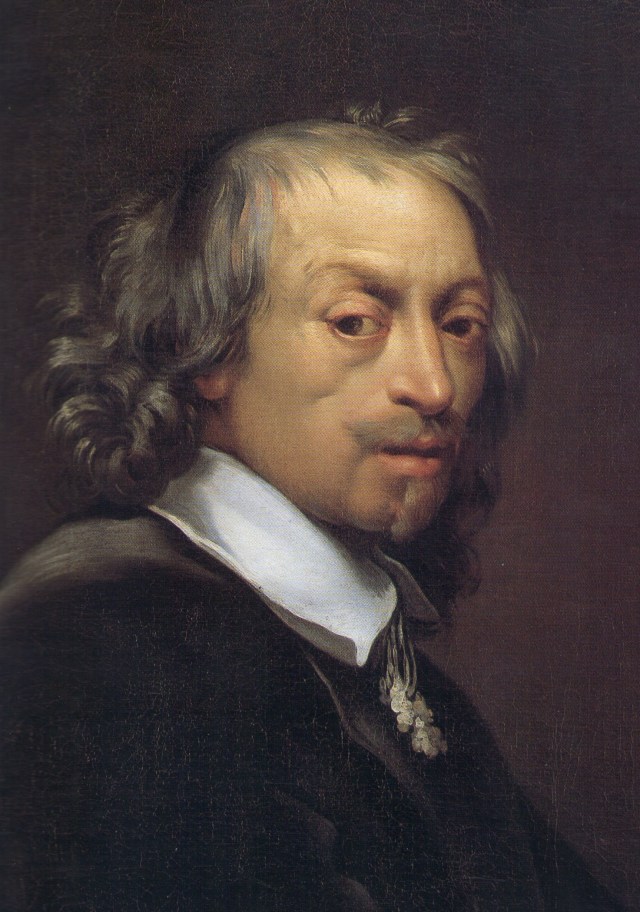
Portrait of Simon Vouet (1665)
Oil on canvas (63 x 52 cm)
Chateau de Versailles
Quite unlike the many dazzling portraits of worthies shown to their best advantage by flattering regalia, the artist eliminated every single superfluous feature here, in order to concentrate on the sitter’s almost hypnotic stare. Using thick paint, he scrupulously described the face, from the parted lips and the thin wisps of hair, each a light-catching streak, to the scar on the cheek.
On March 31st, 1663, Francois Tortebat became a member of the Royal Academy of Painting and Sculpture, together with Nicolas Loir, Noel Coypel and Claude Lefevre, among others. The decision to elect them came at a time when the new institution was regularizing the situation of many artists who belonged to the Guild of St. Luke, and it was taken “without any examination other than the recognition the company has of their merit”. The new members promised “to execute without delay the works they must present”, though Tortebat only fulfilled his obligations on April 11th, 1665.
Sober in the extreme, his canvas stands out from the other presentation pieces, which are mostly half-length portraits of artists surrounded by works providing a key to their identity. The explanation for this probably resides in the fact that the sitter, Simon Vouet (1590-1649), whose daughter had married Tortebat in 1643, had been dead for sixteen years. This, in turn, raises the question of how Tortebat managed to execute the work. The position of the shoulders and the head, shown in three-quarter profile, together with the steady gaze, reveals it to be a self-portrait. While other portraits of Vouet, such as the drawing by Ottavio Leoni (1625, Staatliche Kunsthalle, Karlsruhe), and the engraving by van Vorst after van Dyck’s painting, prove that the artists had a left parting that is shown on the right here, as in his self-portrait (Lyon, Musee des Beaux-Arts) thus indicating the use of a mirror which inverted the image. The self-portrait that Tortebat based his presentation piece on shows a sitter who had lost a great deal of weight and must have been executed fairly late, perhaps around 1648-49, the last years of Vouet.
 Old Masters