
MEIFFREM COMTE (1630-1705)
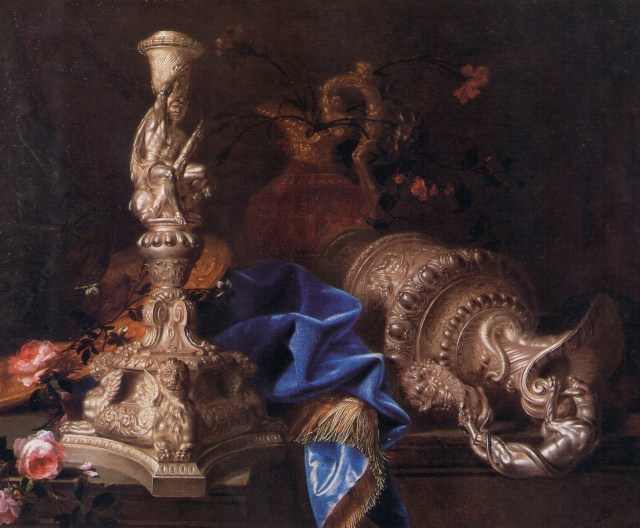
Still Life with a Candelabra and Ewers
Oil on canvas (85 x 105 cm)
Musee de Versailles
We know very little about Meiffrem Comte. After training locally in his hometown of Marseilles, he worked both in Aix-en-Provence, where he was affiliated to the Guild of St. Luke, and Marseilles. He would appear to have been quite successful, judging for his affluence. For reasons unknown to us, he stayed in Paris in 1671 and 1675, frequenting the Gobelins’ studio. On his return to Marseilles, he occupied the post of Master Painter of the King’s Galleys until 1693.
The many works attributed to him are still lifes of different degrees of complexity, mostly featuring pieces of gold or silverware. They represent variations on a theme superbly illustrated by the present picture. For a long time, certain objects in his pictures have been linked with the silver furniture made for Louis XIV, which was melted down in accordance with a decree issued on November 14th, 1689, when the kingdom was beset with financial difficulties.
The ewers figuring in the Versailles work crop up in numerous paintings by Meiffrem Comte. The one at the back can be identified in at least four pictures. The ewer reclining on its side recurs more frequently, still. Its handle, featuring a snake coiled around a dog, reminds us of two vases, each decorated with a medallion picture of Eloquence or Architecture. The upper part of the ewer can be seen in other works by Meiffrem Comte, on jugs bearing illustrations of other scenes, either of tritons, like here, or of processions, as in the works of the Staatliche Kunsthalle in Karlsruhe and the Musee des Beaux-Arts in Valenciennes.
The questions raised by the candlestick are altogether different. It belongs to a series of 12 pieces known as the Labours of Hercules and shows the hero after he has overcome the bull that was laying waste to Crete. Designed after drawings by Lebrun, the set was exhibited at Versailles in the Mercury Room, not far from Guido Reni’s famous four paintings of Hercules’ labours that are now at the Louvre.
The apparently casual way in which the objects, drapery and flowers are arranged is actually the result of skilful organization. The layout is stabilized by the horizontal line of the entablature on which the silverware is placed and the vertical line of the candlestick. The space is given depth by the slant of the ewer lying on its side and the structure of the paintings is strengthened by the oblique and harsh lighting. Comte’s extraordinary skill in reproducing the subtle differences of sheen in the silver pieces is equal as his virtuoso rendering of the drape’s blue velvet whose back is lined with satin.
 Old Masters