
JEAN RANC (1674-1735)
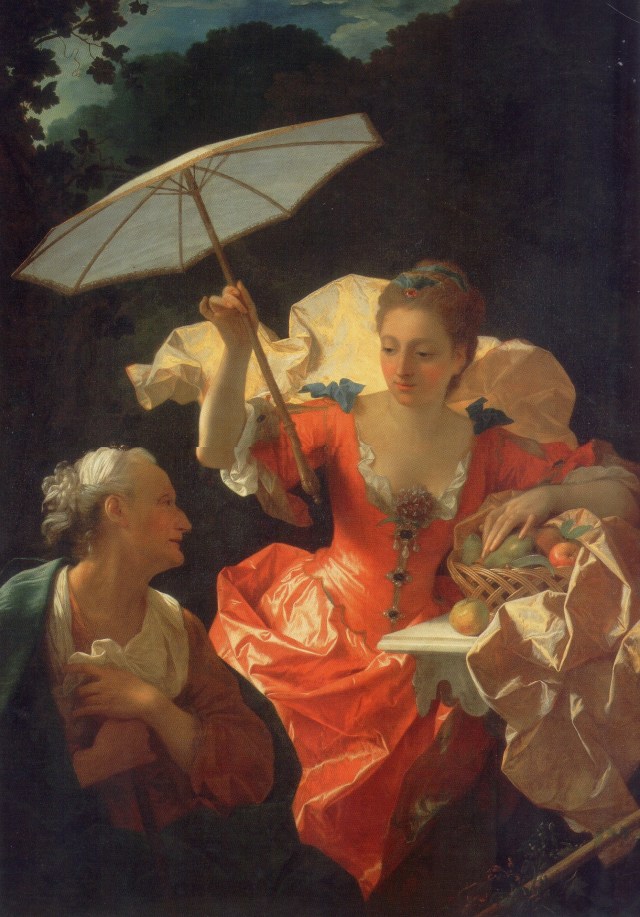
Vertumnus and Pomona (c. 1710-1720)
Oil on canvas (171 x 119 cm)
Musée Fabre, Montpellier
To enlarge the image, right-click on it, then “Open in a new tab”
Jean Ranc was initially trained by his father, Antoine, a Montpellier portraitist with a good reputation, and then by Hyacinthe Rigaud (1659-1743) in Paris, whose niece he married in 1715. Despite some bitter setbacks in his dealings with the Royal Academy, he was protected by the Court (Portrait of Louis XIV, Musee Fabre, Montpellier). In 1722 he left for Spain, where King Philip V was looking for a talented portrait painter to replace the French painter Michel-Ange Houasse (1680-1730). As the leading court painter Ranc made numerous portraits of members of the royal family in the manner of Rigaud. However, his Spanish career came to a dramatic end. Accused of being behind the fire that destroyed the Alcazar of Madrid in 1734, he was expelled from the court and he ended up dying in the Spanish capital a year later.
Jean Ranc chose one of the most poetic mythological stories as the subject of his masterpiece. The story of Vertumnus and Pomona was a popular theme in 18th-century painting. Ranc, an unremarkable portrait painter, could not gain admission to the Royal Academy as a history painter; and it was an engraving by Nicolas-Etienne Edelinck (1681-1767) produced after the Musee Fabre’s painting, that enabled it to be attributed unequivocally to Ranc. The stylistic characteristics displayed here by the artist are the most successful and convincing that he achieved.
Ranc has portrayed one of the love stories related by Ovid in his Metamorphoses (XIV). Pomona, a wood nymph, protects her orchard and garden from the violent gods of the fields. Vertumnus, who is in love with her, changes his appearance in order to seduce her. It is in the guise of an old woman that he tells her the edifying story of Anaxaret, an indifferent and insensitive beauty whose suitor, Iphis, committed suicide out of despair, after which Venus transforms her into a stone statue. Vertumnus reveals his real self to Pomona, who moved by the story, allows herself to be seduced.
Jean Raoux, to whom Ranc may have known, would sometimes give to his models the appearance of mythological heroines, as did Hyacinthe Rigaud and Nicolas Largilliere. Despite academic conventions, there was a growing hybridisation of different genres during this period. Ranc shows Pomona in her orchard, listening with keen interest to the old woman whose tender expression is touching. These delicate figures lack the individuality required for commissioned portraits, but they are certainly based on real models.
The Northern (Dutch-Flemish) influence is obvious in the beauty of the contre-jour (the light source projected from behind the subject), the realistic details of the still-life and the bodice’s jewels. The work of Adriaen van der Werff (1659-1722) also provides some similarities to Ranc’s Vertumnus and Pomona through its rather cold chiaroscuro and mannered gestures. In any case, the Northern influence, the elegance and lightness of this work are clearly evocative of the Parisian art of 1710-1720.
 Old Masters