
JACQUES-ANDRE-JOSEPH AVED (1702-1766)
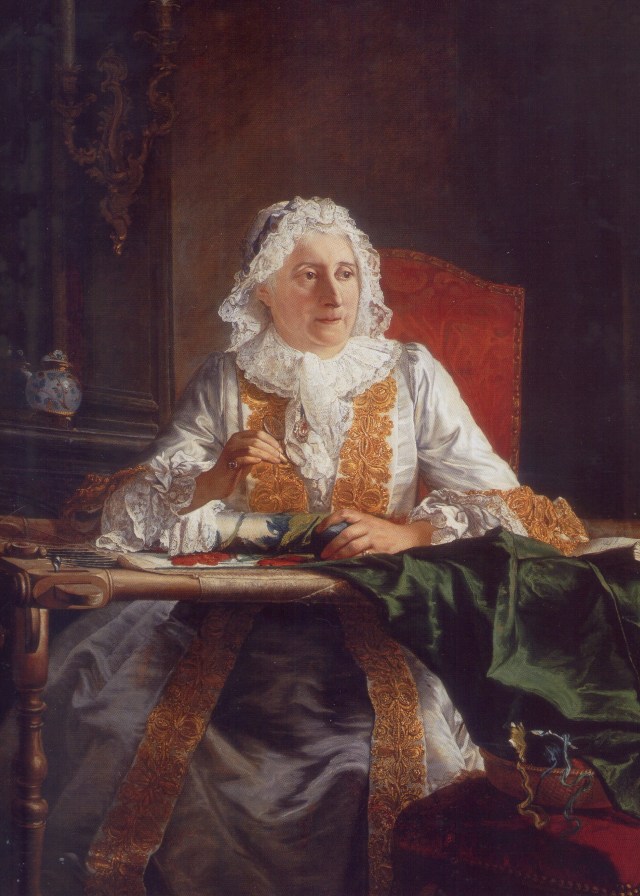
Portrait of Madame Crozat (1741)
Oil on canvas (138 x 100 cm)
Musée Fabre, Montpellier
To enlarge the image, right-click on it, the “Open in a new tab”
Aved was one of the greatest French portraitists of the mid-18th century, ranking with Louis Tocqué (1696-1772), Jean-Marc Nattier (1685-1766), Hubert Drouais (1699-1766), Maurice Quentin de La Tour (1704-1788) and Jean-Baptiste Perroneau (1715-1783)
His father was a physician and he was orphaned when he was a little boy. He was brought up in Amsterdam by one of his uncles who was a captain in the Dutch army. He trained in Amsterdam under the French painters Francois Boitard (1652-1722) and Bernard Picart (1673-1733) and he took a great interest in Dutch painting. This influence marked his style permanently, to the extent that he was nicknamed “the Dutchman” This penchant for Dutch art was not unusual in France at a time when there was a phenomenal enthusiasm for this school of painting among collectors and artists (Jean-Antoine Watteau, Jean-Baptiste Pater and Francois Boucher) Aved himself was a celebrated collector and possessed several Rembrandts.
On returning to Paris, he was able to study under the portraitist Alexis-Simon Belle (1674-1734) and later, in 1731 he was approved by the Royal Academy, where he was received in 1734. Aved’s clients were diverse in origin: royal, aristocratic and bourgeois. A friend of Chardin, and probably also of Boucher and Carle van Loo, he exhibited his portraits at the Salon every year until 1759. Aved is noted for his intimist portraits in which his love of painting real life, together with his psychological insight, combined to produce works of true greatness.
This masterpiece played a leading role in the development of 18th-century French portraiture towards greater naturalness and intimism. The sitter, Marguerite Legendre d’Armeny, is an eminent representative of the turn-of-the-century’s upwardly mobile grande bourgeoisie (high-ranking civil servants, bankers and entrepreneurs). She was the daughter of a fermier général = farmer-general (the name given in France under the Ancien Regime to a tax collector) and magistrate of Toulouse. In 1690 she married Antoine Crozat (1655-1738), one of the most powerful financiers in France, who had made his money in banking and seaborne trade.
From the 17th century on, French portraiture was characterised by a stateliness and decorum that defined the social status of the sitter. The result was a flamboyant manner and a tendency to idealize gestures and facial features. Aved turned portraiture into something truer to nature and to psychological reality. This development began to emerge in about 1740
Madame Crozat is shown, pince-nez in one hand, seated at her tapestry (an activity that was considered befitting for gentlewomen) but looking away from it, her attention is caught by something. She is elegantly and expensively dressed (as the journalist for the Salon noted: “white satin gown with Spanish gold embroidery, a splendid cap of English lace”), but in an understated, homely manner. Her face and character are rendered truthfully. There is a feeling not only of strength and nobility but also of goodness.
The harmonies of white, beige and grey, so characteristic of 18th-century French painting, contrast charmingly with the splashes of green and red in the armchair and the tapestry. Aved avoids artifice, but goes beyond simple imitation, thus achieving the poetry that, according to theorists such as Diderot and Sir Joshua Reynolds, was one of the criteria for a portrait.
The figures in Dutch genre paintings were rarely portraits, and these mannered works were often very small in format. Aved’s innovation was to combine a scene of daily life with a portrait. Madame Crozat is shown working at her household tasks, in a canvas of large size, one suitable for a woman of high rank. The sense of poetry of everyday life, rediscovered by the great Dutch painters and continued by Aved, adds greater depth to this beautiful psychological study.
 Old Masters