
FRANCOIS-XAVIER FABRE (1766-1837)
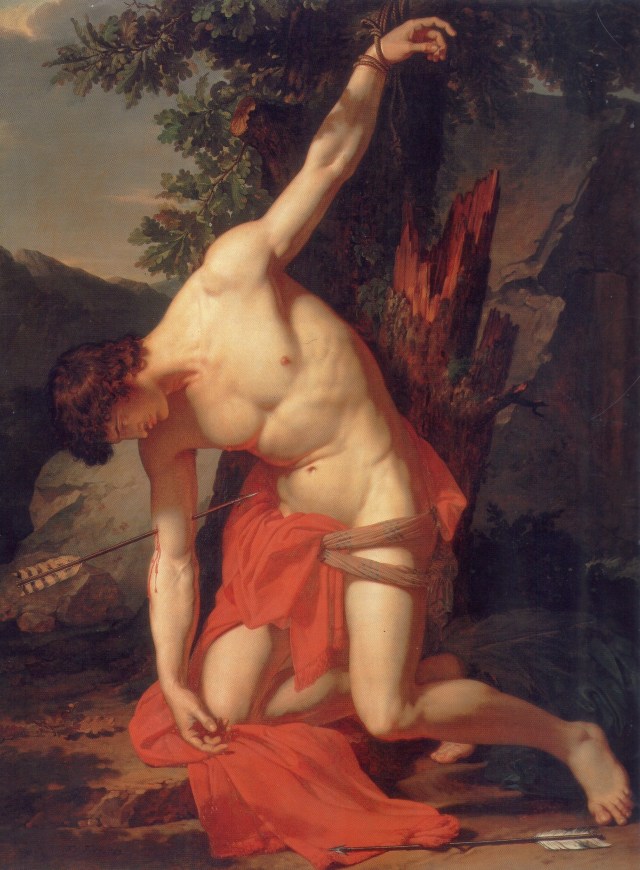
The Dying Saint Sebastian (1789)
Oil on canvas (196 x 147 cm)
Musée Fabre, Montpellier
To enlarge the image, right-click on it and then “Open in a new tab”
Born in Montpellier on 1 April 1766, Fabre was one of the first students to benefit from the education provided by Montpellier’s Societe des Beaux-Arts. In 1783, thanks to the support of his mentor, the artist Jean Coustou, who recommended him to Joseph-Marie Vien, Fabre become a pupil of Jacques-Louis David in Paris. In 1787, the same year that he won the Prix de Rome (1), Fabre moved to Rome and quickly became known as one of the most promising French painters in the city. On his return to France, disgusted by the fanaticism of the revolutionaries he decided to return to Italy and in 1794 he settled in Florence. There he achieved rapid success thanks to the patronage of Louisa de Stolberg, Countess of Albany, widow of Prince Charles Edward Stuart.
As a portraitist, with an eye to the cosmopolitan elite passing through Tuscany, Fabre indulged his passion as a collector and authority on works of art. He also showed an early interest in landscape; he was encouraged by other exiled French artists with whom he was in contact at the start of his time in Florence. While deeply involved with the life of the Florentine court, Fabre was nonetheless rather marginal to the core of the school of David, although he made visits to Paris in 1806 and 1809-1810. He devoted all his time to his friendship with the Countess of Albany. When the Countess died in 1824, Fabre decided to donate his large collection of paintings to his hometown and devoted the last years of his life to the creation and benefit of his museum by paintings portraits of his close friends, like Victor-Ferdinand de Nattes (Musée des Augustines, Toulouse) and Louis-Augustin Gache (Musée Fabre, Montpellier).
Winner of the Prix de Rome for painting in 1787, Fabre was able to take his place at the Academie de France in Rome where he completed the various academic exercises that were required. He made sketches of historical sites, copies of the masters, landscape studies, but also life drawings of the male figure. The artist placed the figure in the centre of the canvas showing to an advantage the saint’s athletic body. According to the canons of the Neo-classical school, the saint does not display any signs of pain or suffering. The beautifully drawn pink draperies contrast with the marble-like sheen of the body while the dark oak tree in the background set-off the saint’s body bathed in a uniform, soft light.
The painting aroused high praise from the director of the French Academy in Rome, Francois-Guillaume Menageot (1744-1816), who asserted that Fabre had distinguished himself with this beautiful figure study. In Paris, the Academy found that the painting was well-executed, and noted the effectiveness of its design and its beautiful palette and commended Fabre on the truthfulness of the figure’s representation. Philippe-Laurent de Joubert, an avid supporter of developing artists, sent to Rome the compliments of Vien. The painting serves as an important milestone in understanding the ambitions of the young history painter, a rising star of French painting, and prefigures the ambitious work Death of Abel (1790, Musée Fabre, Montpellier).
(1) The Prix de Rome was a prize awarded by the French Royal Academy of Paintings and Sculpture. The winners of the prize were sent to Rome for two or four years to study classical art and the works of the great masters of the Reanaissance (mainly Raphael and Michelangelo). The students lodged in the Villa Médicis which still is the seat of the French Academy in Rome.
 Old Masters