
JEAN-FRANCOIS DE TROY (1679-1752)
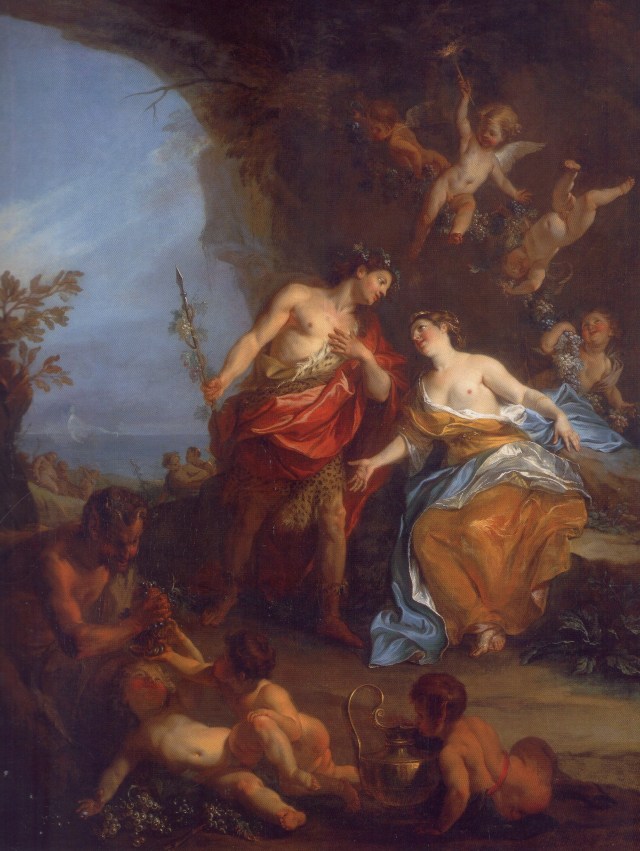
Bacchus and Ariadne (1725)
Oil on canvas (163 x 130 cm)
Musée Fabre, Montpellier
To enlarge the picture, right-click on it and “Open in a new tab”
Jean-Francois de Troy, the most important and gifted member of a family of painters from Toulouse, was taught by his father, Francois de Troy (1645-1730), the celebrated portraitist patronised by Madame de Maintenon and Madame de Montespan. His indolent, pleasure-seeking ways (by which he was chided by Dezallier d’Argenville and his father) prevented him from excelling at his studies at the Royal Academy. It was at his family’s expense that he set off for Rome in 1698, where he stayed for seven years. De Troy seems to have been inspired by Veronese and Guercino, although there is no denying the stylistic influence of his father and Antoine Coypel
Until 1724, de Troy painted mainly small-format mythological and religious pictures. He received a few royal commissions, some for the City of Paris (The Fathers of the City Implore Saint Genevive for Rain, 1726, Saint-Etienne-du-Mont, Paris) and others for the Gobelins tapestry company between 1737 and 1746. De Troy succeeded Nicolas Vleughels as director of the Academie de France in Rome, serving from 1738 to 1751.
His tableaux de mode, (see my post Before the Ball) depictions of elegant high society (such as The Loose Garter, private collection, New York) are skilful transcriptions of the mannered genre scenes produced by the Dutch masters Gabriel Metsu and Frans van Mieris. These genre scenes were very successful in their day and pre-dated those of Nicolas Lancret, Francois Boucher and Jean-Baptiste-Simeon Chardin
In about 1779, this painting was given to the Societe des Beaux-Arts de Montpellier by the great collector of French painting and drawing Marie-Joseph de Guignard, Vicomte de Saint-Priest (1732-1794). It followed the changing fortunes of that honourable society and in 1806 ended up in the city museum that preceded the Musee Fabre.
De Troy shows the Cretan princess Ariadne on the island of Naxos, after being abandoned by Theseus (whose ship can be seen in the distance, sailing away) welcoming Bacchus’ offer of marriage. The god of wine is accompanied by his followers: bacchantes, putti, satyrs and Silenus. Cupid flies around Bacchus and Ariadne, carrying the flaming torch for the wedding to come.
This beautiful picture shows the influence of Antoine Coypel in its cool colours and elegant forms. In fact, it is very interesting to compare it with Coypel’s own version of Bacchus and Ariadne (1693, Philadelphia Museum of Art). There are also echoes of Peter Paul Rubens in the satyr and the putti in the foreground. If de Troy’s treatment of the subject looks somewhat outdated, it is due either to his own education or to the requirements imposed by the person who commissioned the painting.
Ariadne does not convey the sensuality of other contemporary female figures by de Troy, but she welcomes her consoler with gratitude and grace. With this nobility of spirit, there is a certain sadness, understandable if one knows the fate of this loving woman saved in extremis from the despair that led Dido to her death.
 Old Masters