
NICOLAS DE LARGILLIERE (1656-1746)
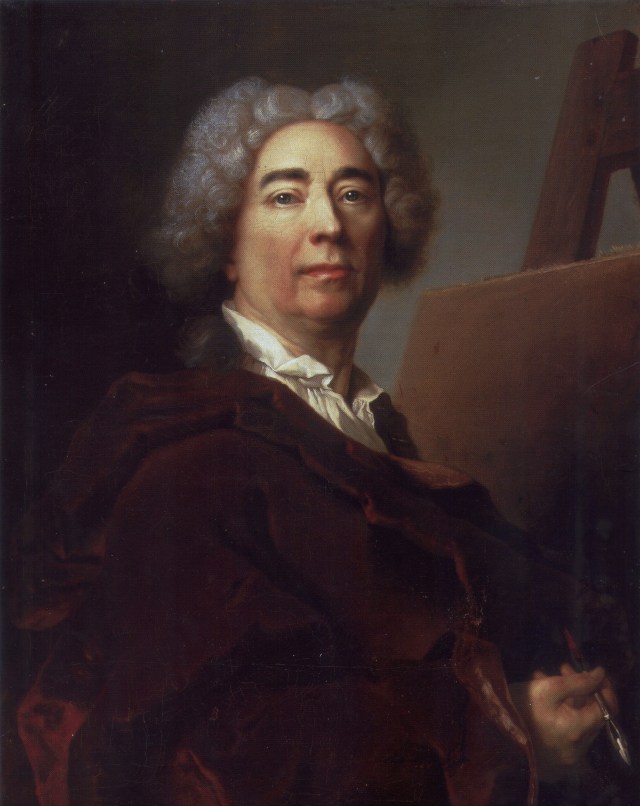
Self-Portrait (c. 1726)
Oil on canvas (80 x 64 cm)
Musée Fabre, Montpellier
To enlarge the picture; right-click on it, then “Open in a new tab”
Largillière, a Parisian educated in Antwerp showed at an early age great aptitudes for painting and was apprenticed to Antoine Goubau (1616-1698). He became a master of the guild of St. Luke at the age of nineteen and two years later he went to London where he was befriended by Sir Peter Lely who introduced him to King Charles II. Largillière received the commission to restore some paintings belonging to the royal collection. He carried out an excellent work and was highly praised by the king who invited him to stay in England. He portrayed numerous members of the nobility and seemed to have a great career in front of him but the growing hostility towards the Catholics decided him to leave England
Returning to Paris he became a member of the circle of artists favoured by Charles Le Brun (1619-1690) Louis XIV’s unofficial Minister of the Fine Arts and responsible for the decoration of Versailles. Largillière’s superb skill made him famous among the noblesse de robe, high-ranking civil servants who had been ennobled by the King or who had purchased titles. Only Hyacinthe Rigaud (1659-1713), who had a more aristocratic clientele was his equal in talent and success. Largillière excelled in depicting his sitters in a way that intimated their social status and office, while also doing justice to their psychological makeup and vividly capturing expressions and stances.
In addition to some 1500 portraits, he painted still-lifes (Musee de Picardie, Amiens and Musee de Grenoble), landscapes (Musee du Louvre, Paris) and religious scenes that were influenced by the Northern artists (Musee du Louvre, Paris and Musee des Beaux-Arts, Arras).
Largillière painted many self-portraits; this example from the Musèe Fabre was executed in 1726 when the artist was 70 years old. The scholars believe that the Montpellier canvas is a replica of the one in the collection of Paul Desmarais. Both derive from the Self-Portrait dated 1711, in the collection of the Chateau de Versailles. In the Versailles work, the painter is seen in a lively attitude, dominating the pictorial space. However, the portraits at Montpellier and in the Demarais collection show him posed, calm and confident. Like Nicolas Poussin in his famous Self-Portrait (1650, Musee du Louvre, Paris) Largillière tightens the composition, depicting himself in the foreground at an easel. Here, we found nothing of all the accessories he had been at pains to present in his Portrait of Charles Le Brun (1686, Musee du Louvre, Paris); the symbols of the liberal arts, antique sculpture, engravings and elaborate drapery. The canvas on the easel is blank, whereas the one at Versailles shows a drawing of The Annunciation.
 Old Masters