
JACQUES-LOUIS DAVID (1748-1825)
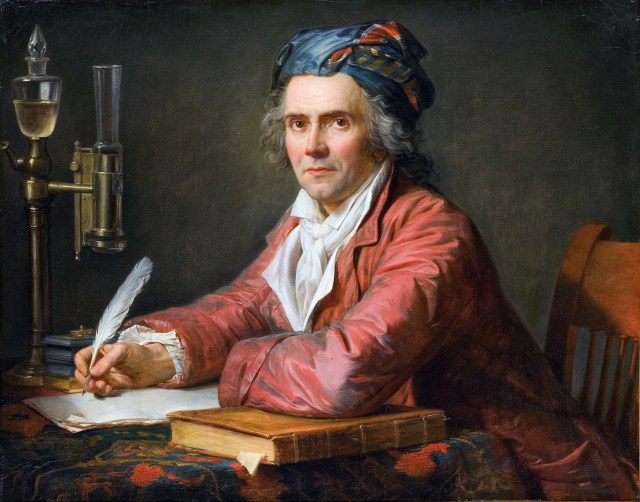
Portrait of Alphonse Leroy (c. 1783)
Oil on canvas (73 x 95 cm)
Musée Fabre, Montpellier
To enlarge the picture, right-click on it, the “Open in a new tab”
A student of Joseph-Marie Vien, David was awarded the Prix de Rome in 1774 and went there with Vien from 1775 to 1780. Upon his return to Paris, he became the head of the Neo-classical school succeding Vien over Francois-Andre Vincent (see Belisarius) and Pierre Peyron. From this point on he accepted in his studio some of the most talented young artists of the time: Francois-Xavier Fabre (1766-1837), Anne-Louis Girodet de Roucy-Trioson (1767-1824), Francois-Pascal-Simon Gerard (1770-1837), Jean Germain Drouais (1763-88) and later Jean-Auguste-Dominique Ingres (1780-1867)
Before the Revolution, his works were of an austere Neo-classicism, portraying epic moments of Greek or Roman history such as Belisarius (1781, Musee des Beaux-Arts, Lille), Andromache Mourning Hector (1783, Ecole des Beaux-Arts, Paris), The Oath of the Horatii (1784-85, Musee du Louvre, Paris), and The Death of Socrates (1787, Metropolitan Museum of Art, New York)
During the Revolution, he was elected deputy to the National Convention and attacked The Royal Academy of Fine Arts for being out-moded and sterile. Davis also organized many of the official ceremonies and painted the grand events of the period The Tennis Court Oath (1791, Musee du Chateau de Versailles) and The Death of Marat (1793, Musee Royaux des Beaux-Arts, Brussels). David was close to Robespierre and was a signatory to the death warrant of Louis XVI, which resulted in his imprisonment at the end of the Terror in 1794. In 1798 he presented his large picture The Rape of the Sabine Women and quickly become a staunch Bonapartist (Napoleon Crossing the St, Bernard Pass, 1801, Chateau de Malmaison, Paris). After Napoleon became Emperor David was appointed Premier Painter to His Majesty and depicted many of the grand events of the First Empire; The Coronation of Napoleon (1806-1807, Musee du Louvre) Distribution of the Eagles to the Army (Musee du Chateau de Versailles). Napoleon’s defeat at Waterloo led to his exile to Brussels, where he painted mainly portraits and mythological subjects.
Alphonse Leroy (1742-1816) was a gynaecologist whose theories and practices caused controversy at the time. His arm rests on a copy of Hippocrates’ The Diseases of Women. The treatment of the background is typical of David, bare and painted in light brushstrokes in shades of brown. His depiction of light creates a halo that concentrates our gaze on Leroy’s face. The colours are half-tints, ranging from pink, and mauve to blue on the satin dressing gown; and the striking dark blue, red and black of the turban. This refined use of colour, the outline of the features and the particularly life-like look of Leroy belong to a tradition of the art of the 18th century in the manner of Jean-Baptiste Greuze
 Old Masters