
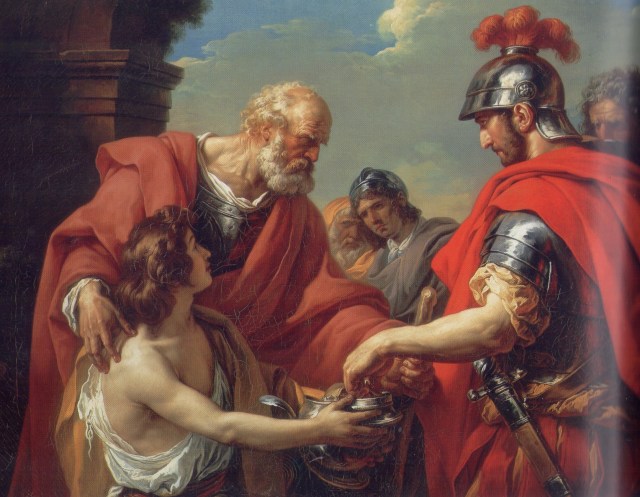
FRANCOIS ANDRE VINCENT (1746-1816)
Belisarius (1776)
Oil on canvas (98 x 130 cm)
Musee Fabre, Montpellier
Vincent initially trained with his father, Francois Elie, a miniaturist from Geneva that had settled in Paris. He was then taught by Joseph-Marie Vien. At the age of 22, he won the Prix de Rome and spent the years 1771 to 1775 at the Academie de France in Rome. On his return to Paris, he became a rising star of the Neo-Classical reaction to Rococo painting. In the Salon of 1777, he exhibited 15 paintings that were very favourably received.
Vincent’s work launched a school of Frenc history painting that was to influence successive generations of artists in the 19th century. Vicent continued in his patriotic vein (see his series of six tapestry cartoons of the Life of Henry IV, 1783-1787; Musee du Louvre and Musee de Fontainebleau) depicting heroic episodes of the history of France. Vincent also executed numerous paintings of religious and Roman historical themes. However, his style became old-fashioned when Jacques-Louis David, with his radical Neo-Classicism, established himself in Paris in 1780. In poor health, Vincent thereafter devoted himself to producing caricatures and portraits, as he had in his early days in Rome. (see my post A Mysterious Gentleman)
The story of Belisarius (approx. 500-565 AD) was immensely popular among the French artists during the last quarter of the 18th century; the subject was covered by Durameau in 1775, Pierre Peyron in 1779, Jacques-Louis David in 1781, and Jean-Antoine Houdon in 1773. At the Salon of 1777, Vincent exhibited his Belisarius together with its counterpart, Alcibiades Taking Lessons from Socrates (Musee Fabre, Montpellier).
When Jean-Francois Marmontel (1723-1779), a writer and friend of the Encyclopedists (the reformist writers of the French Encyclopedia, 1751-1772), published his novel Belisarius in 1767 the book was censured and placed in the Index of Prohibited Books by the Sorbonne. Even so, its success was considerable. Marmontel’s work took his inspiration from texts by Procopius of Caesarea, to tell the story of Belisarius, Justinian’s best general. then occupied with the restoration of the Roman Empire. Belisarius fought the Vandals in Tunisia, reconquering North Africa, and then crushed the Ostrogoths in Italy. In 563, at the height of his fame, he was accused of treason, tried and condemned to death. According to another version of the story, he was blinded and banished to wander abroad as a beggar.
Marmontel made Belisarius an outcast sage and philosopher who was harshly critical of power and the monarchy. Betrayed by the emperor he had served so well, he represented the man victim of ingratitude and high-handedness. It is very clear why the novel aroused the wrath of the censors and the admiration of Voltaire, enlightened sovereigns and the Philosophes
Following Marmontel, Vincent has painted Belisarius, supported by a young guide, accepting alms from one of his soldiers who has recognized him and has lowered his eyes in pity at the sight of his disgraced commander. The same feeling is shown by the men surrounding the three protagonists. In a derisory and moving gesture, Belisarius is using his helmet to collect the alms. Here Vincent is endeavouring to convey states of mind. Like the followers of Caravaggio, he has chosen to depict the characters in a half-length format focusing on the action itself, the gestures are sober and almost solemn; this was an unusual approach in an era that was increasingly drew towards theatrical gestures and poses. The thick pigment, the vivid and intense colouring, and the dramatic shading produce a moving effect of realism and physical presence.
 Old Masters