
ALLAN RAMSAY (1713-1784)
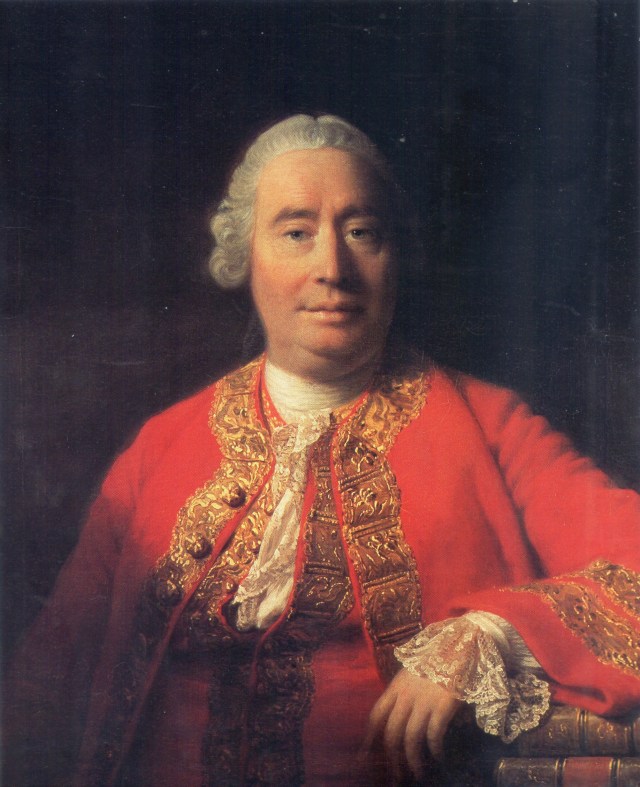
David Hume (1766)
Oil on canvas (76 x 63.5 cm)
Scottish National Portrait Gallery, Edinburgh
David Hume (1711-1776), eminent Scottish philosopher and historian, one of the greatest figures of the Enlightenment, son of Joseph Home of Ninewells and Catherine Falconer, attended the University of Edinburgh at the unusual age of twelve, at a time when fourteen was normal. At first, because of his family, he considered a career in law, but he came to have, in his own words “an insurmountable aversion to everything but the pursuits of Philosophy and general Learning”. He had little respect for the professors of his time, telling a friend in 1735 “there is nothing to learn from a professor, which is not to be met with in books” Not surprisingly he did not graduate but he was appointed Keeper of the Advocates’ Library at Edinburgh. His tenure there, and the access to research materials it provided resulted in Hume’s writing his six-volume History of England (1754-57) which became a bestseller and the standard history of England in its day. In 1757 he resigned as a consequence of the clerical interference in his liberal choice of books for the Library.
From 1763 to 1766 he served as Secretary to the British ambassador to the French court, Francis, 1st Earl of Hertford (1718-1794); returning to London in the company of Rousseau, to whom he offered protection in England. He remained in London until 1769 when he returned to Edinburgh where he died, unmarried in 1776. Hume was revered in his lifetime for his exemplary character and sweetness of nature. He has claims to be regarded as the greatest British thinker of the Enlightenment, as well as the supreme master of English prose if the 18th century.
In Ramsay’s portrait, Hume is shown in the scarlet, semi-military “uniform” he had been asked to wear on being appointed secretary to general St Clair’s Military Legation at Vienna and Turin. On being shown the portrait of Hume, which he had specially asked to see, George III remarked to Ramsay that, while he considered it a good likeness he thought the dress “rather too fine”, to which Ramsay wittingly replied “I wished posterity should see that one philosopher during your Majesty’s reign had a good coat upon his back”
The inclusion in the picture of a volume of Tacitus pays tribute to Hume’s eminence as a historian; the other volume, which we should expect to bear the name of an ancient philosopher, but which is unidentified by title or author, must have been intended to allude to Hume’s own philosophical distinction; and that Ramsay set out to portray his friend principally as a philosopher is suggested by the character of the picture as a whole, as well as being supported by the anecdote concerning George III just cited.
Hume’s features would doubtless have presented a problem to any portrait painter, to judge at any rate from Lord Charlemont’s description: “Nature, I believe never formed any man more unlike his real character than David Hume… His face was broad and fat, his mouth wide and without any other expression than that of imbecility. His eyes vacant and spiritless…” Whatever Lord Charlemont may have felt about Hume’s physical appearance Ramsay created out of it a compelling image of philosophical detachment and intellectual power. The deep shadows bathing the lower part of the figure and the modulations of dark tone that model the features reflect Ramsay’s study of Rembrandt.
 Old Masters