
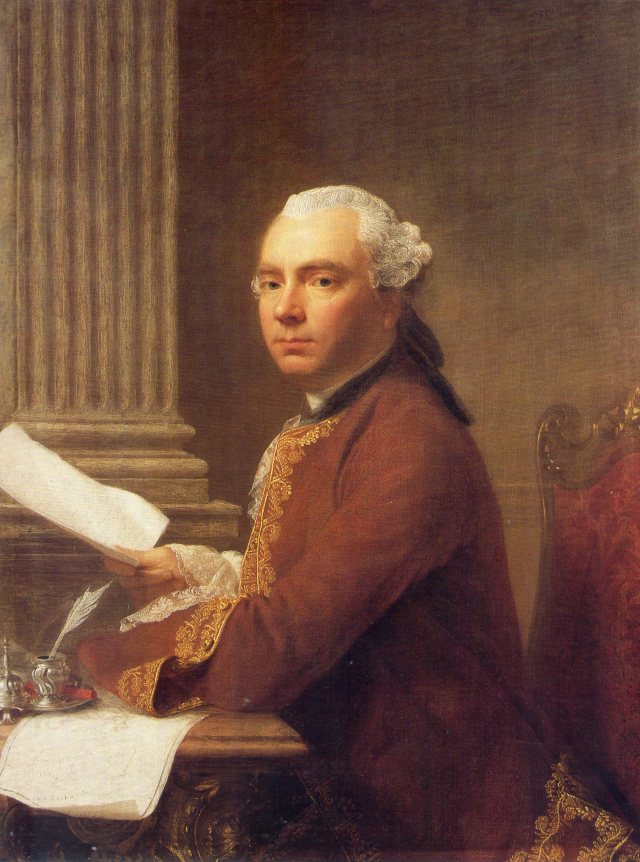
ALLAN RAMSAY (1713-1784)
Robert Wood (1755)
Oil on canvas (98 x 74 cm)
National Gallery, London
Robert Wood (1716-1771), was a classical scholar, archaeologist and politician; educated at the University of Glasgow. After early travels in France, Italy and the Middle East. he joined John Bouverie and James Dawkins on their expedition to Asia Minor and Greece, setting out from Naples in the spring of 1750 and arriving at Athens in the early summer of 1751, having visited Egypt, Palestina, Syria, and a great part of the European and Asiatic coasts of the Hellespont and the Bosphorus, together with most of the Greek islands. The result of these voyages was the publication, in 1753, of The Ruins of Palmyra, followed by The Ruins of Baalbek in 1757.
In 1753 he accompanied the young Francis Egerton, 3rd Duke of Bridgewater, as his tutor on the Grand Tour, becoming a member of the circle of Allan Ramsay and Robert Adam in Rome, and sitting for his portrait to Mengs as well as to Ramsay. He returned to England in 1755 and entered upon a political career, becoming Under-Secretary of State in 1756 and serving as Member of Parliament for Brackley; he was elected a member of the Society of Dilettanti in 1763 and published in 1769 his influential Essay on the Original Genius of Homer.
Ramsay has portrayed his friend as a scholar at work, he seems to be looking at the viewer as if he was expecting a visitor. His countenance shows a pleasant disposition and a placid nature. The artist has chosen to portray Wood between two verticals represented by the fluted pilaster and the back of the gilded chair, the result is well-balanced composition; a soft light illuminates the scene in a uniform manner. Ramsay has used a series of warm, earthy colours that harmonize naturally, the brown coat blends with the back of the reddish-brown chair as well as the bare wall in the background with its darker shades of brown.
 Old Masters