
ALLAN RAMSAY (1713-1784)
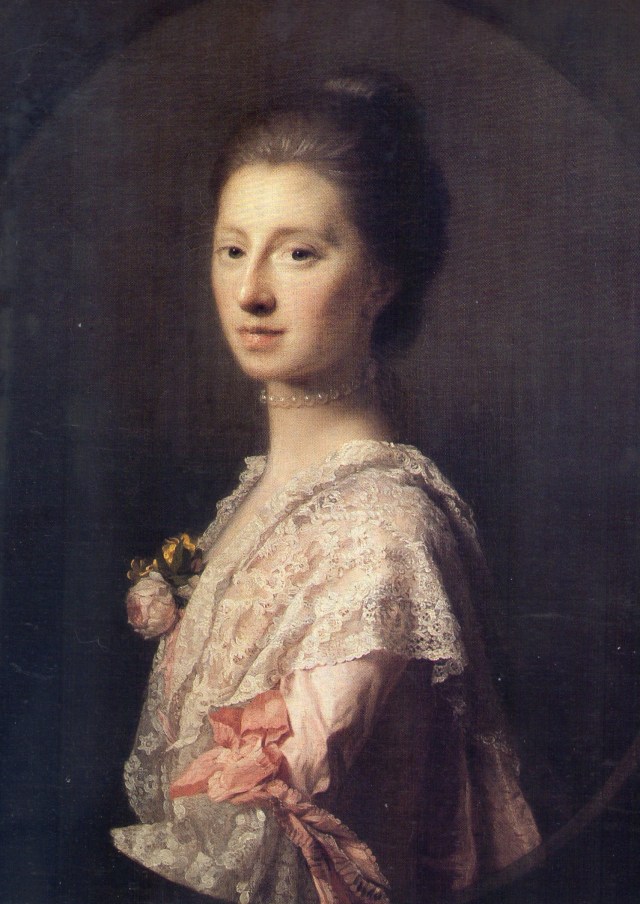
Anna Bruce of Arnot (1767-68)
Oil on canvas (74 x 62 cm)
National Gallery of Scotland, Edinburgh
Allan Ramsay was born in Edinburgh, Scotland, the son of Allan Ramsay Sr, poet and the author of The Gentle Shepherd. He started his artistic education at the Academy of St. Luke in Edinburgh; at the age of twenty, he moved to London where he spent the next three years studying at the St. Martin’s Lane Academy. In 1736 he travelled to Italy where he would spend three years, he stayed in Rome and then in Naples where he studied under Francesco Solimena.
On his return to Scotland, he set up a studio in Edinburgh where his dignified and elegant portraits began to attract the attention of the fashionable society. His full-length portrait of Archibald Campbell, 3rd Duke of Argyll (National Gallery of Scotland, Edinburgh) brought him great success. After a short period in Edinburgh Ramsay decided to move to London where he quickly became very popular, not only for his artistic skill but also for his pleasant manners and his varied culture.
In 1754 he returned to Italy where he would stay until 1757; he visited Rome, Florence, Naples and Tivoli. He spent his time researching, copying and buying Old Masters, as well as visiting and sketching antiques and archaeological sites. He earned a considerable income with his portraits of distinguished British travellers. This trip involved more literary and antiquarian research than art. After his return, he was appointed Principal Painter in Ordinary to King George III beating his competitor Thomas Hudson to the post. The king commissioned so many royal portraits to be given to ambassadors and colonial governors that Ramsay had to employ extra assistants to cope with them.
Ramsay gave up painting in 1770 to dedicate himself to literary pursuits. Unfortunately, his health was shattered by an accident that resulted in the dislocation of his right arm and his wife’s death in 1782. With unflinching tenacity, he endeavoured to finish a portrait of the king and then left the rest of them, nearly 50, to his assistants as he departed once more towards Italy. He lingered there to end up returning to England in 1784, where he died on 10th August.
Anna Bruce (d.1810) was the daughter of General Sir John Hope-Bruce, 7th Bt. of Craighall and Marianne Denune, as the heiress of Arnot she married, in 1774, Thomas Williamson, an Edinburgh surgeon that took the name Bruce. The sitter was a half-cousin of Ramsay’s first wife Anne Bayne. The earlier literature accepted a date of c. 1760 for the portrait; but the style is characteristic of Ramsay’s work of the later 1760’s. In 1963 a more plausible date, c.1765, was proposed by Robin Hutchinson and Colin Thompson in their catalogue of the exhibition Allan Ramsay (1713-1784) His Masters and Rivals. More recently Duncan Macmillan has suggested 1767 (Scottish Art 1460-1990, Edinburgh 1990), although without supporting evidence. In 1989 Dr Lindsay Errington noticed that the dress worn by the sitter is almost exactly repeated in a bust-length portrait of Anne Broun, Lady Dalrymple, which is now known from records of payments to Ramsay to have been begun in 1766 and completed in 1767; and it seems likely that Anna Bruce sat for her own portrait at about the same time, or, in view of its more developed style, a little later.
Affinities have long been detected between Anna Bruce of Arnot and the work of Gainsborough in his Bath period (see my post Mrs Mary Little), and Sir James Caw, for instance, assumed that Ramsay was influenced by the poetical manner which Gainsborough was developing in the 1760’s (see: JLCaw “Ramsay Portrait Painter”, Walpole Society, XXXII, p.60 ) I personally believe that either of the artists could have influenced his counterpart through the annual exhibitions at the Royal Academy where the artists could observe and study the work of their colegues. What the portrait of Anna Bruce of Arnot certainly reflects is a change in Ramsay’s style during the late 1760’s where his portraits are infused with a delicate and softer countenance giving them a poetic air. The same can be said about the great Gainsborough.
 Old Masters