
PETER PAUL RUBENS (1577-1640)
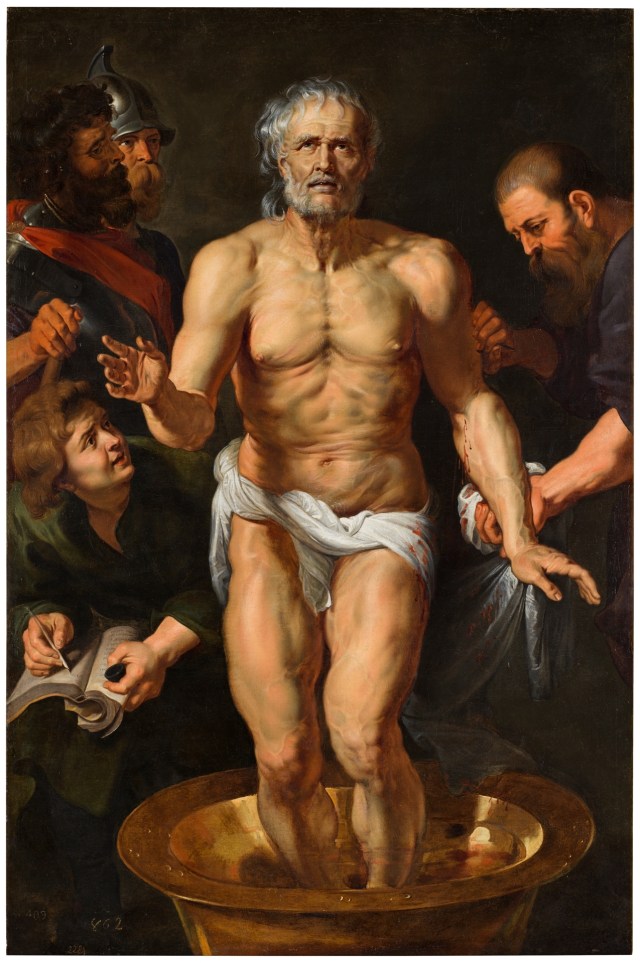
The Death of Seneca (c. 1516)
Oil on canvas (181 x 120 cm)
Museo del Prado, Madrid
To enlarge the picture, right-click on it, then “Open in a new tab”
This painting is a simplified version of a striking picture now in the Alte Pinakothek in Munich, a work in which Rubens summed up the admiration of a whole generation for the ancient Roman philosopher Seneca (c. 4 BC – 65 AD). Seneca’s stoic philosophy had been particularly popularized by the Flemish scholar Justus Lipsius, who had taught the artist’s younger brother Philip, as well as many of his closest friends. Indeed, it was probable that while working on an illustration of the dying philosopher for Lipsius’s edition of Seneca’s works (published in Antwerp in 1619) Rubens conceived the idea of making a painting on the subject.
The ancient historian Tacitus describes how the man who had been both tutor and counsellor to the emperor Nero was in AD 65 ordered by his cruel and ungrateful pupil to commit suicide. The order was brought by soldiers and Seneca duly opened his veins. then dictated a speech which was to become famous. But he still lingered in life, even after his friend Statius Annaeus, a doctor, had given him a dose of hemlock. So, to hasten the flow of blood, he entered a warm bath, and from there, he was carried to a steam bath where he finally expired.
Much in the Munich Seneca, and in the present painting, derives from Tacitus; the soldiers, the doctor (the bearded man with his sleeves rolled back), and the young scribe intent on catching the philosopher’s last words, whose theme, Rubens indicated, was stoic virtue. (The first four letters of the Latin word VIRTUS appear on the young man’s page). From Tacitus too comes the bath. But the picture is not so much a narrative as an image of Seneca as a kind of pagan saint, surrounded by selected characters and motifs from the different moments in the story of his death. It is also notable that Rubens has shown the doctor severing the vein in Seneca’s arm; the painting thus avoids a clear allusion to suicide, something condemned by the Church. Rubens’s Seneca is a heroic martyr, mysteriously illuminated in his dying moments, as he stands upright, naked in a bronze basin.
As a good Stoic, Seneca dies on his feet. But there was another reason Rubens portrayed him in this way. He was inspired ( and would have wanted viewers of his painting to recognize this) by an ancient statue, a Hellenistic figure in black marble (now in the Lovre, Paris) which is today thought to represent an African fisherman but which in the artist’s time, and for two centuries after, was considered to be a portrait of the dying Seneca. Discovered and identified in Rome a few years before Rubens’s arrival there in 1603, the sculpture had been acquired by Cardinal Scipione Borghese, who restored and exhibited it.
In fact, neither the Borghese statue nor Rubens’s bust really portrays Seneca. Luckily Rubens did not discover that the authentic sculptural portrait, identified in the XIXth century, shows a plump man with a placid expression. But such authenticity scarcely matters, for, like Raphael’s ancient poets and philosophers in the frescos of the Stanza della Segnature of the Vatican, Rubens’s Seneca is more a spiritual than a physical portrait, and it seems that the boy at Seneca’s feet taking down his last words of wisdom was inspired by the similar figure at the feet of Homer in Raphael’s Parnassus.
 Old Masters