
CARAVAGGIO (1571-1610)
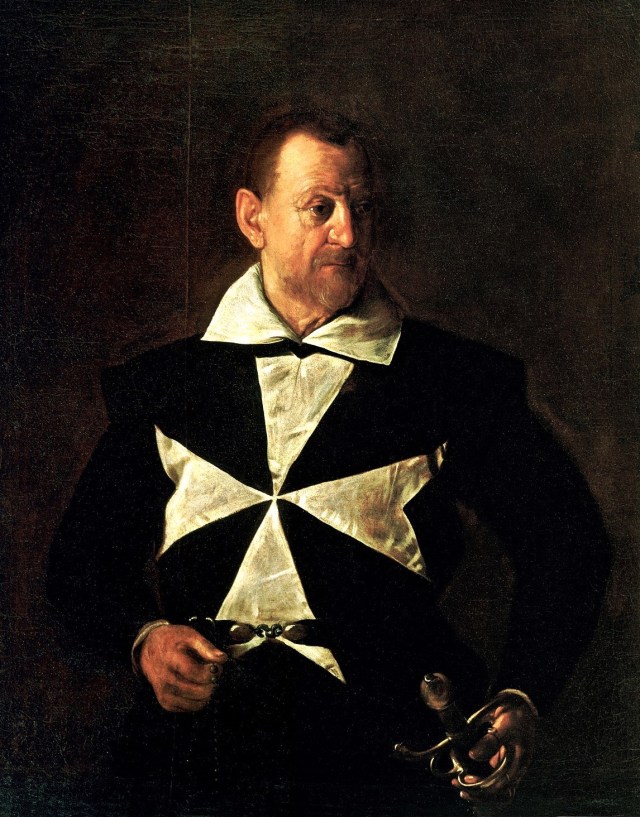
Portrait of a Knight of Malta (c. 1608)
Oil on canvas (118 x 95 cm)
Palazzo Pitti, Florence
To enlarge the picture, right-click on it, then “Open in a new tab”
The Portrait of a Knight of Malta is one of the works that the Italian scholar Mina Gregori has convincingly identified as belonging to the artist’s late period. The painting shows a confidence of modelling that is characteristic of the work of Caravaggio; there is very little evidence of the methodical building up of layers of paint, with forms instead being suggested by the dashing application of paint across the surface. This extreme abbreviation of form is most obvious in the single highlight that defines the knight’s thumb on his sword hand. Similarly, a touch of white terminates the adjacent finger and another white touch gives vitality to the eye.
Painted after Caravaggio’s exile from Rome, where his paintings had adorned the palaces of the most refined collectors of his day (like Cardinal Francesco Maria del Monte, who owned the Portland Vase now in the British Museum), this work still conveys something of the sophistication of the rarefied world that his violent actions had forced him to leave (he had killed a man in a brawl) The knight turns away from us, seemingly deep in thought with a melancholic air.
Caravaggio was in Malta in 1608. when he is known to have painted a full-length Portrait of Alof Wignacourt in Armour (Louvre, Paris). The sitter was the Grand Master of the Order of the Hospital of Saint John of Jerusalem; a XIth’s century secular order created to defend the pilgrims visiting the Holy Land. The knights of the order defended the Aegean island of Rhodes against Muslim attacks until 1522 when they were forced to retire, settling in 1530 in Malta, where they continued to resist the expanding Ottoman empire. It is recorded that Caravaggio was made a member of this order in July 1608 in recognition of his services as a portraitist, but in December of the same year, he was expelled following a violent quarrel with a nobleman.
For many years it was believed that the gentleman portrayed here was Alof de Wignacourt, to whom the sitter resembles. However, in 1989, the great art historian Marco Chiarini (1933-2015), found evidence that linked the sitter in this portrait to Marquess Antonio Martelli, a member of a distinguished Florentine family and a knight of the Order of Malta. In 1997; the British art historian and expert on Caravaggio, John Gash, published an article in the Burlington Magazine confirming the identity of the mysterious sitter:
(…) New evidence discovered in the archives of the Order of St. John in Valetta, enables us to set aside these misgivings, establishing, as it does, that Fra Antonio Martinelli, who indeed belonged to the well-known Florentine family, was resident in Malta in 1607-08 as a leading member of the Order’s governing council.” (The identity of “The Knight of Malta” = “The Burlington Magazine” Vol. 139, No. 1128, p. 156)
 Old Masters