
TINTORETTO (1518-1594)
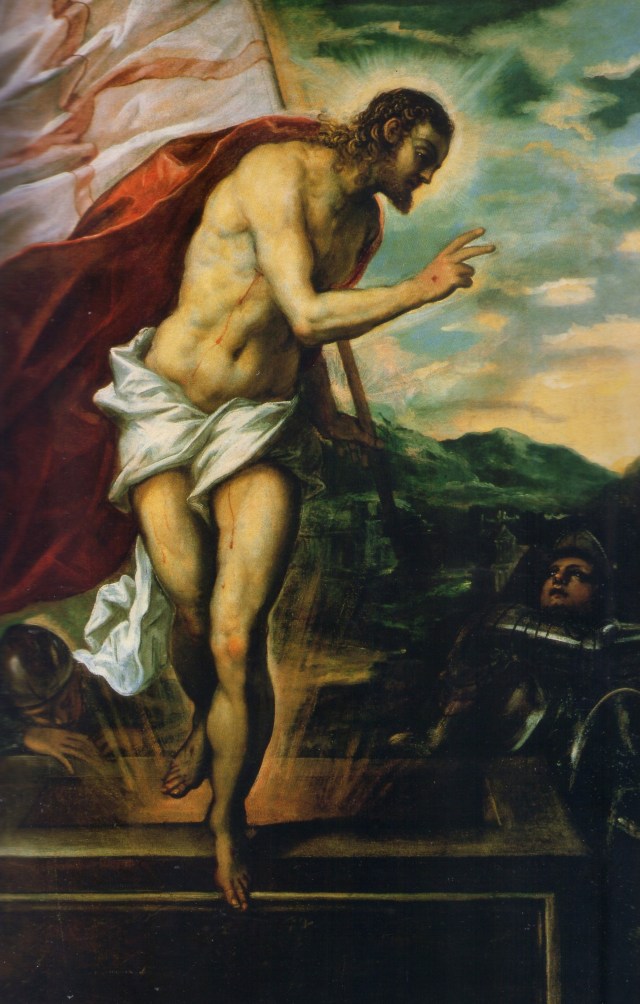
The Resurrection (c. 1565-70)
Oil on canvas (201 x 139 cm)
Queensland Art Gallery, Brisbane
To enlarge the picture, right-click on it, then “Open in a new tab”
Few painters have treated the resurrection of Christ more dramatically than Jacopo Robusti better known as Tintoretto. In the most famous painting of the subject, at the Scuola di San Rocco in his native Venice, he depicted Christ bursting from his tomb, propelled upwards in a blaze of light. In another painting, for the Palazzo Ducale, he depicted an athletic Christ springing forward in an outburst of divine energy.
In the present painting, there is less stress in the violence and momentum of the resurrection. Although an afterglow radiates from within the tomb, Jesus is not shown erupting from it. Instead, he floats above and in front of his sepulchre. Every muscle in his body is galvanized into renewed life as He twists back to raise his hand to bless one of the two soldiers guarding his grave. The awakened guard recoils in terror at the apparition looming over him while his companion sleeps on.
In his other hand, Christ holds a triumphal banner bearing the red cross of the resurrection, a vivid red cloak is draped over his back, and he wears a loincloth around his waist. A billowing wind bends the staff of his banner and makes flutter his drapery, slightly lifting the red cloak.
As in many of Tintoretto’s compositions, more than one light source has been introduced; there is the light from the left, starkly illuminating one side of Christ’s body while throwing the rest of it into shadow. Then there is the light from the tomb and the halo, and finally, there is the sun in the background on the right rising over the hills.
These different light sources contribute to the central meaning of the picture. The disjunction between the illumination of the figure of Jesus and the natural light that falls on the landscape beyond him underlines the supernatural character of the resurrection itself. Just as the rising sun heralds a new day, so the risen Christ brings light and new life to the world.
This work is a quite recent addition to Tintoretto’s oeuvre and its exact origins are as yet undocumented. Tintoretto’s first biographer, Carlo Ridolfi, does not mention any resurrection picture like it in his biography of 1642. He does mention a Risen Christ in the private collection of Niccolo Corradino in Padua, but the figure of Christ in that work was only half-life-size. Ridolfi also mentions a Resurrection in the Palazzo Foscarini in Venice, but the scale and format of the Queensland painting are clearly those of an altarpiece. The composition’s vanishing point is high, which implies a low viewing point, providing further evidence that the painting was meant to be positioned above an altar.
 Old Masters
Hi you have a wonderful Posting site It was very easy to post it’s nice
LikeLiked by 1 person
Thank you very much Raina, I am glad you found it interesting. I will visit your blog. Have a nice day.
LikeLike