
ANTHONIE DE LORME (c.1610-1673)
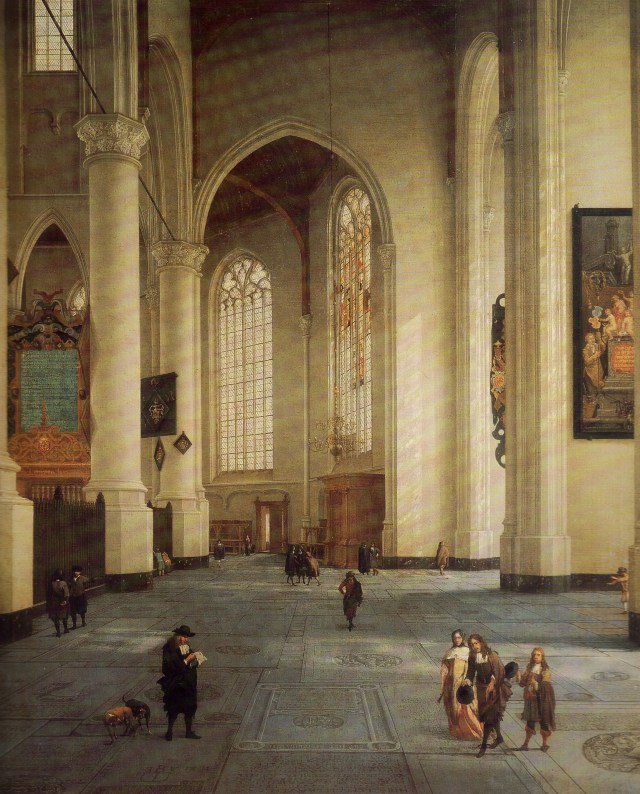
Interior of the St. Laurenskerk, Rotterdam (1660-65)
Oil on canvas (87 x 74 cm)
National Gallery of Ireland, Dublin
To enlarge the picture, right-click on it, the “Open in a new tab”
The following text belongs to the entry written by Brian P. Kennedy, Assistant Director, National Gallery of Ireland, for the catalogue of the exhibition “European Masterpieces from the National Gallery of Ireland” which toured Australia (Canberra and Adelaide) between June 1994 and January 1995. I was very lucky to be living in Australia at that moment and I had the pleasure to see the exhibition in Canberra. Mr. Kennedy’s words are in italics.
The date of birth of Anthonie de Lorme is unknown and the earliest document mentioning him is a deed that he witnessed for the painter Jan van Vucht on 11 October 1627. His name appears in several documents concerning van Vucht who it is assumed was de Lorme’s teacher. Van Vucht was a painter of church interiors and de Lorme specialized in this genre. De Lorme was married in Rotterdam in 1647 and he died there in 1673. He owned a shop that sold paintings and art supplies. His earliest known picture, which dates from 1639, depicts a church interior. Throughout the 1640s, he painted imaginary church interiors, influenced by van Vucht and by Bartholomeus van Bassen. In the early 1650s, de Lorme began to paint real views of the interiors of churches, especially St. Laurenskerk in Rotterdam. De Lorme was influenced by the Delft painters who specialized in church interiors, Gerard Houckgeest and Hendrick van Vliet, but more than any other, he sought to emulate the works of the gifted artist Pieter Saenredam who lived in Haarlem.
During the 17th century, a special category of Dutch painting known as “perspectives” was developed based on the theory of spatial construction and central perspective. Architectural views of the interior or exterior of buildings, particularly churches, were much sought after for their technical artistry, creating a marvellous illusion of space. These paintings were labour-intensive and consequently expensive to purchase or commission. The master of this genre was the Haarlem painter, Pieter Saendram. De Lorme’s paintings tend to have muted colouration, subtle light effects and magnificent details.
Research has shown that after 1652 de Lorme used his local church, the St. Laurenskerk, as his subject. This church, the largest of Rotterdam’s Reformed churches, also known as the Grote Kerk (Great Church) was painted by de Lorme on at least thirteen occasions. The view shown here is looking east along the southern ambulatory with the choir on the left. A Gothic building, dating from 1409 to 1425, it suffered significant damage from air bombing during the Second World War. It has now been restored although none of the memorials shown by de Lorme has survived. In the 17th century, churches were burial sites and venues for social interaction as much as religious worship. There were frequent complaints to church authorities about disorder and excessive noise, even during religious services. De Lorme shows small groups of people gathered talking in the background of the picture, while in the foreground a man reads a letter, and to the right, a man bows to someone who is out of the picture space. Based on comparison with other works by de Lorme, and because it has the airy expanse and the open composition of his later paintings, it is probable that the Interior of the St. Laurenskerk dates to the early 1660s.
 Old Masters