
JOSE ANTOLINEZ (1635-75)
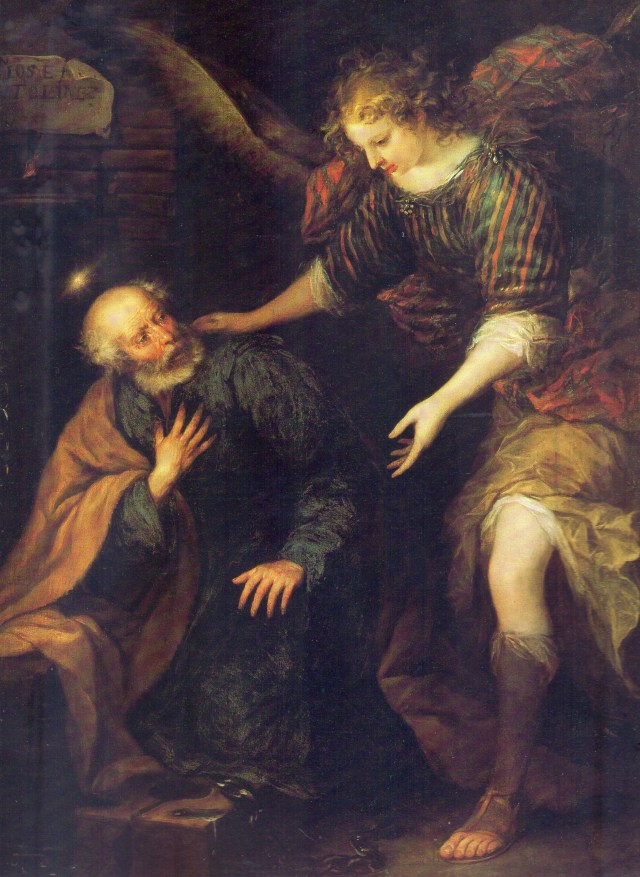
The Liberation of St. Peter (c.1670)
Oil on canvas (167 x 128 cm)
National Gallery of Ireland, Dublin
To enlarge the picture, right-click on it, then “Open in a new tab”
The following text belongs to the entry written by Adrian Le Harivel, Curator, National Gallery of Ireland, for the catalogue of the exhibition “European Masterpieces from the National Gallery of Ireland” which toured Australia (Canberra and Adelaide) between June 1994 and January 1995. I was very lucky to be living in Australia at that moment and I had the pleasure to see the exhibition in Canberra. Mr. Le Harivel’s words are in italics.
Antolínez was a vain and arrogant individual who had a very high opinion of himself. He claimed to be descended from the minor nobility and made use of the sword to back up his claim. He trained with Francisco Ricci the son of a Bolognese artist who worked in a confident Baroque style. Antolínez had the opportunity to study Titian’s paintings in the Spanish Royal Collection; the works of the Venitian master were a source of inspiration for the Spanish artist. He produced a large number of principally religious paintings before his early death. His figures are elegant and richly dressed. There are also occasional genre scenes and portraits by him and there was contemporary praise for his mythological subjects.
The Acts of the Apostles in the New Testament tells how St. Peter was arrested and imprisoned in Jerusalem, during a period of persecution by Herod Agrippa. Miraculously, an angel came to lead him to freedom past his two sleeping guards. The composition, showing the arrival of the angel in the cell, derives from The Liberation of Saint Peter by Jusepe Ribera of 1639 (Museo del Prado, Madrid), but it has been reworked to a vertical format. Details such as the wooden block and fetters are also similar, but Antolinez creates a more tender relationship between the figures, without the intense descriptive passages, or use of light found in Ribera. An ethereal angel in theatrical costume, with a striped tunic, billowing drapery and buskins, reassures the bemused and almost tearful saint, who is depicted in the traditional way as an elderly man with a golden cloak over dark blue draperies.
Antolínez used the same model for at least three other depictions of St. Peter: The Crucifixion of St. Peter (Dulwich College Picture Gallery, London); The Descent of the Holy Ghost (Museo de Bellas Artes de Bilbao), and The Liberation of St. Peter (Colegio de Santa Murca, Madrid). Antolínez was clearly influenced by the colourful, mannered style of the Madrid school and also by the Venetian and Flemish colourists, whom he could have seen in the Royal collection. It is difficult to date his works, which span only fifteen years. The Dublin picture, with its awareness of Murillo and delicate, almost rococo brushwork, is placed late in his oeuvre.
 Old Masters