
JAN LAGOOR (Active in Haarlem 1645-1671)
ADRIAEN VAN DE VELDE (1636-1672)
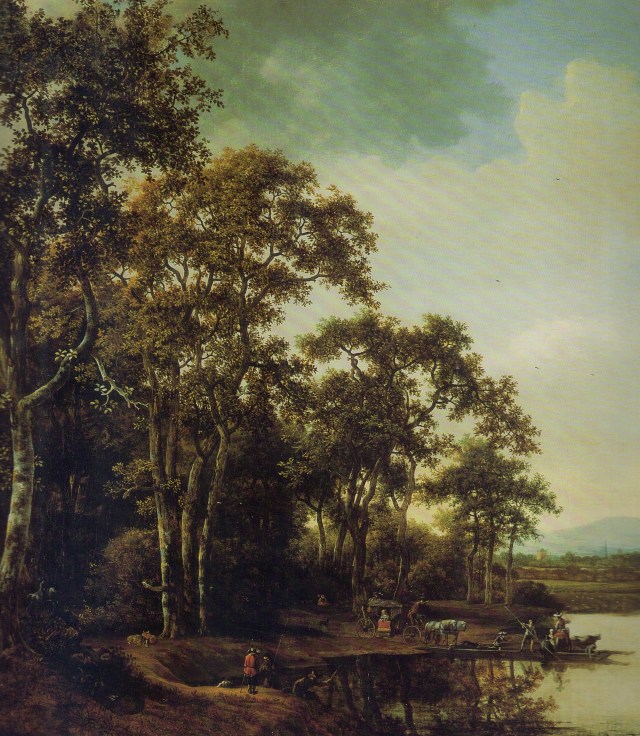
The Ferry Boat (c.1665)
Oil on canvas (88 x 80 cm)
National Gallery of Ireland, Dublin
To enlarge the image, right-click on it, then “Open in a new tab”
The following text belongs to the entry written by Brian P. Kennedy, Assistant Director, National Gallery of Ireland, for the catalogue of the exhibition “European Masterpieces from the National Gallery of Ireland” which toured Australia (Canberra and Adelaide) between June 1994 and January 1995. I was very lucky to be living in Australia at that moment and I had the pleasure to see the exhibition in Canberra. Mr. Kennedy’s words are in italics.
Jan Lagoor: There is little biographical information about Jan Lagoor. Neither his birthplace nor his date of birth has been established and he is first recorded in 1645 when he became a master of the Guild of St. Luke in Haarlem. He must have remained in Haarlem for some years because in 1649 he was cited as a member of the Guild. During the 1660’s he settled in Amsterdam and in 1659 bankruptcy proceedings were taken against him. He may have been a pupil of the Haarlem painter of landscapes Cornelius Vroom (1519-1661) who also frequently painted in a non-dramatic, gentle and less sombre manner than those artists who were strongly influenced by Jacob van Ruisdael (1628-82). Lagoor’s artistic career parallels that of Ruisdael in date.
Adriaen van de Velde: He was born in Amsterdam, the son of Willem van de Velde I (1611-1693) and the younger brother of Willem van de Velde “the Younger”, both celebrated marine painters. Houbraken states that van de Velde studied with his father and then with Jan Wijnants (1632-1684). There is no evidence to suggest that he travelled to Rome about 1635 and is more likely that the Italianate influence in his work came from other Dutch artists. His first dated works are etchings from 1653 and his first oil paintings are of 1654.
The Ferry Boat was sold in 1876 as a work by Jacob van Ruisdael (1628-1682) and it entered the collection of the National Gallery of Ireland in 1901 with an attribution to Jan Hackaert. Walter Armstrong, Director of the National Gallery of Ireland from 1892 to 1914, attributed the picture to Joris van der Hagen, and it was included in a monograph about the artist (1932). During the 1970’s, it was suggested that the painting was by Lagoor and it was published by Keyes in 1979 as Lagoor, with staffage (figures and animals, etc) by Adriaen van de Velde. He related The Ferry Boat, which he dated c. 1655, to two paintings by Lagoor, one in Budapest and the other in Vienna. He drew similarities between the three paintings in their “elongated trees with attenuated branches… each treated as a separate entity, in a forest that assumes more the character of a well-kept parkland”
On the evidence of this and other paintings, Lagoor was an excellent painter who deserves to be better known. His woods are less heavily massed than those of other artists and he delights in painting the tall, sinuous trees and thinning them out in a clever composition. Van de Velde was one of the most popular staffage painters of his period and his figures can be found in landscapes by Ruisdael, Hobbema, van der Heyden and Willem van de Velde “the Younger”, among others. His signature appears on the little boat and his delicate figures do not intrude on the landscape but provide charming focal points of interest. The quality of Dutch landscape painting in the 17th century is such that, aside from the obvious masters like Ruisdael and Hobbema, minor artists like Lagoor reached standards of excellence which, at a less propitious time in the history of European painting, would have won them great distinction.
 Old Masters