
NICOLAS LANCRET (1690-1743)
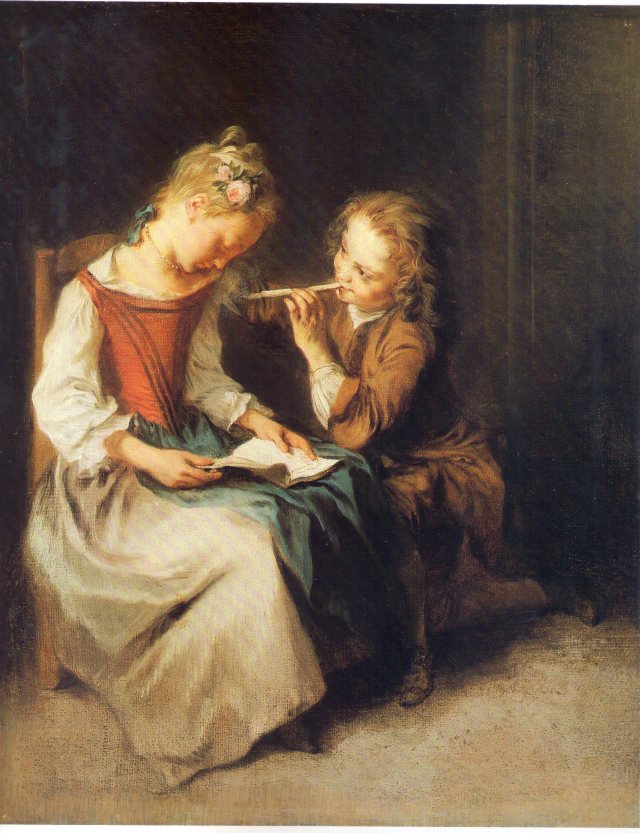
Mischief (1735)
Oil on canvas (36 x 29 cm)
National Gallery of Ireland, Dublin
To enlarge the image, right-click on it, then “Open in a new tab”
The following text belongs to the entry written by Fiounnala Croke, Curator, National Gallery of Ireland, for the catalogue of the exhibition “European Masterpieces from the National Gallery of Ireland” which toured Australia (Canberra and Adelaide) between June 1994 and January 1995. Fiounnala’s words are in italics.
Lancret’s first known master was Pierre Dulin, a history painter who, although largely forgotten today, was acknowledged by Lancret as the first to “open his eyes”. By 1708 he was studying at the school of the Royal Academy from which he was expelled as a result of a quarrel with a fellow student. In 1711 he competed for the Prix de Rome, the highly coveted five-year scholarship in Rome. After the first failed attempt, he entered the studio of Claude Gillot (then director of costumes and designs for the Opera) with whom the great Watteau had studied. Ballot de Savot, friend and biographer of Lancret, recalls that Watteau advised the younger artist to leave his master and to turn to “the master of masters, Nature”
Despite an early friendship, the two artists fell out after an episode at the Place Dauphin when two exhibits by Lancret were mistaken for the work of Watteau, so closely Lancret was modelling his style on his friend’s. With the death of Watteau in 1721 and of Gillot, the following year, the road was clear for Lancret to pursue a career producing paintings of elegant parties. He was very successful and his works achieved high prizes. These works are characterized by their grace and inventiveness but they lack the poetry of Watteau. Lancret gradually developed a more personal style, less dependent on Watteau. His figures became more robust than the doll-like creations of Jean-Baptiste Pater (1695-1736), and he sought to introduce a greater versatility in subject matter and setting. Historians and critics alike concur that from 1730 onwards Lancret produced his finest works.
Possibly painted c. 1735, this charming interior scene shows a girl dozing, her book resting in her lap. A boy, determined to disturb her, kneels to blow smoke into her face from a lighted roll of paper, his animated and mischievous expression contrasting with her relaxed and sleepy features. The figures are a variation of the theme of lovers depicted in both Watteau and Lancret’s fêtes galantes (1) a type of subject matter treated also by Pater. Similar poses of adults, as in Lancret’s The Flute Lesson(Musee du Louvre, Paris), are here adapted as a study of two children. Instead of an open park, they are set in a dimly lit room. The bright colours are saved for the girl whose dress has a red bodice and a blue apron matched by the hair ribbon. The flush of her cheek is echoed in the rose pinned in her hair, a detail of exquisite elegance.
(1) fêtes galantes is a French expression that means “gallant parties” and applies to paintings that depicted elegant garden parties. They were also described as fêtes champêtres (rural/country parties)
 Old Masters