
JEAN-SIMEON CHARDIN (1699-1779)
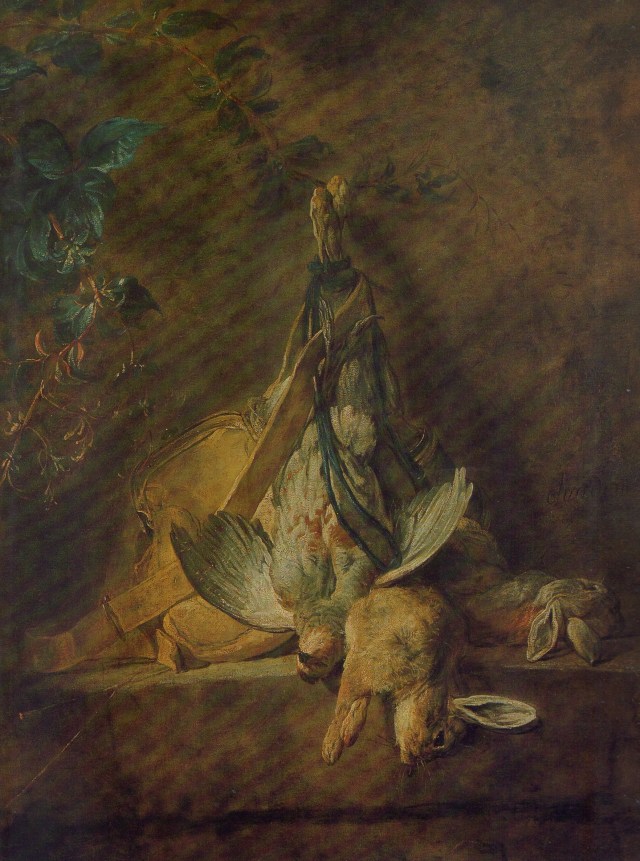
A Still Life: Two Rabbits, a Grey Partridge and a Game Bag (1731)
Oil on canvas (82.5 x 65 cm)
National Gallery of Ireland, Dublin
To enlarge the image, right-click on it, then “Open in a new tab”
The following text belongs to the entry written by Fiounnala Croke, Curator, National Gallery of Ireland, for the catalogue of the exhibition “European Masterpieces from the National Gallery of Ireland” which toured Australia (Canberra and Adelaide) between June 1994 and January 1995. Fiounnala’s words are in italics.
Although one of the foremost artists of his generation, Chardin did not receive the thorough education offered by the Academie Royale de Peinture et Sculpture. While little is known about his early training, he enrolled in the Academie de St. Luc in 1724 and spent time in the studios of Pierre-Jacques Cazes and Noel-Nicolas Coypel. In June 1728 he exhibited several paintings including The Ray Fish and The Buffet. Just four months later, through the intervention of Nicolas de Largilliere, he was admitted to the Academie Royale as “a painter skilled in animals and fruit”, the lowest-ranking category in the Academy’s hierarchy of genres.
Chardin worked slowly, and painstakingly, planning each composition carefully, consequently, his output was not great and this is surely the reason why he painted so many replicas. Although his earliest works represent dead game and still-lifes he diversified around 1730 and began to paint scenes of kitchen interiors, and from 1732-33 genre scenes and figure compositions. Later still he ventured into the field of portraiture. Chardin was a regular contributor to the Salons. He received a royal pension in 1752, and five years later he was granted living quarters in the Louvre, where he died at the age of eighty.
This is one of the two paintings by Chardin bequeathed to the Gallery by Sir Hugh Lane, the art dealer and Director of the National Gallery of Ireland who tragically drowned when the “Lusitania” sank in May 1915. Two other 18th-century French works included with the bequest, then given to Watteau and Greuze, are now generally regarded as the work of followers. Together, however, these four pictures reflect the collector’s taste for 18th-century French genre painting. Chardin’s Still-Life is the finest of them. It is his earliest signed and dated still-life. The rabbits, partridge, game bag and powder flask are arranged in a pyramid resting on a stone ledge, the sharply horizontal ledge, broken by the profile view of the head and forepart of one of the rabbits, forms a contrast to the vertical axis created by the slaughtered animals
As always with Chardin, the overall effect is neither rigid nor harsh, the branch of honeysuckle creeping in from the upper left-hand side relieving the severity of the composition. The blue of the honeysuckle petals is picked up again by the dark blue ribbon which binds the animals’ legs, while the spot of blood on the neck of one of the rabbits adds a note of realism. The painting strikes a solemn note. Through a controlled use of muted tones of browns and grey, and by combining a formal composition with accurate, quick brushstrokes, Chardin has succeeded in imbuing a simple still-life, the lowest of genres, with a sense of dignity.
 Old Masters