
SEBASTIANO RICCI (1659-1734)
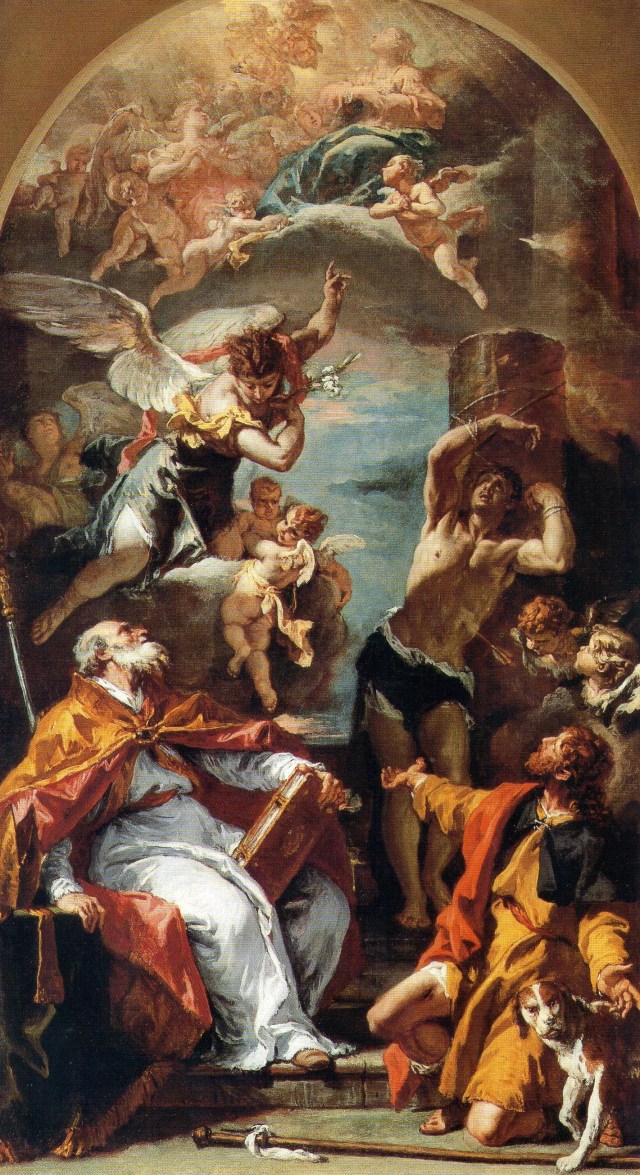
The Virgin in Glory with the Archangel Gabriel and Saints Eusebius, Roch and Sebastian (1724-25)
Oil on canvas (113 x 63 cm)
Los Angeles County Museum of Art, Los Angeles
To enlarge the image, right-click on it and the “Open in a new tab”
The text that follows was written by the great British art historian and museum curator Philip Conisbee (1946-2008) for the catalogue of the exhibition “The Ahmanson Gifts: European Masterpieces in the Collection of the Los Angeles County Museum of Art” which was held at Los Angeles in 1991. The two footnotes are mine:
“Sebastiano Ricci was the leading decorative painter of late 17th and early 18th century Venice, the artist who revived for his own time the great 16th-century Venetian tradition of decoration that is associated mainly with Paolo Veronese. Ricci took Venetian painting into its final burst of energy and glory in the 18th century and was followed by other Venetian decorative painters such as his nephew and collaborator, Marco Ricci,; the great vedutisti Bernardo Bellotto and Antonio Canaletto; Gianantonio Pellegrini; and Gianbattista Tiepolo. All these artists soon established international reputations and led extraordinarily itinerant careers all over Europe. Ricci was no exception, painting throughout northern Italy, as far south as Florence and Rome, and also in Vienna where he worked at the Schoenbrunn Palace. In 1712 he travelled with Marco to England where he spent four years. He later returned to Venice via Paris where he had a considerable influence on French decorative painting.
Ricci executed impressive cycles of frescoes for churches and palaces as well as altarpieces, smaller devotional paintings, and mythological works. The most important source for his art was Veronese, whose masterpieces he studied in Venice. From Veronese, he learned his use of the colour and handling of paint and how to organize a large and complex composition into a clear and legible design without sacrificing dynamism or decorative effect. Of course, Ricci also assimilated the dramatic, illusionistic techniques of Italian baroque painters of the 17th century.
The museum’s painting is a work of Ricci’s full maturity and the model for an altarpiece described as “one of Ricci’s most splendid and luminous”; completed in 1725 for the chapel of the Venaria Reale, a royal hunting lodge in the outskirts of Turin. During the last decades of his life, Ricci received a number of important commissions from the House of Savoy in Turin for over-doors, large historical paintings, and altarpieces. He painted these works in Venice because he was not allowed to visit Turin owing to a youthful indiscretion over a woman. (1)
Ricci’s altarpiece for the Chapel of Saint Hubert at the Venaria Reale is arguably the greatest picture he did for Turin. It was placed in the left transept, facing an altarpiece by Trevisani: The Immaculate Conception with Saint Louis of France and the Blessed Amadeus of Savoy. The two other altarpieces were provided by Sebastiano Conca. The paintings are now located in the main hall of the University of Turin (the reason for this is unknown to me) The chapel of the Venaria Reale was been renovated by Filippo Juvarra during the 1720s and the commission of the altarpieces must have been part of that programme. The altarpiece is rich in colour and was, in its original location, beautifully complemented by a surround of polychrome marble designed by Juvarra to strike a note of colour in the general whiteness of the chapel. Ricci’s altarpiece was greatly admired by the 18th-century travel writers Charles Nicolas Cochin and Jean Jacques Lalande as well as the Abbe de Saint-Non, one of the great amateurs of painting of the day, who called it “a very beautiful painting”
An altarpiece of this type does not depict an event of religious history but rather serves to focus the mind and the emotions of the spectator on a matter of doctrinal truth. (2) Ricci’s altarpiece is a glorification of the Virgin and her Annunciation. At the top of the painting, in the holiest sphere, the Virgin is shown surrounded by adoring angels in the glory of light, the light of Heaven. Below the vision is pointed out by the flying figure of the Archangel Gabriel, who is carrying a white lily, a symbol of the Virgin’s purity, and addressing the three saints positioned on the ground. Shown are St. Sebastian, the 3rd-century martyr, who is tied to a column, his side pierced by an arrow; the 14th-century St. Roch, accompanied by his dog (the sore on his right leg refers to his work in caring for the victims of the plague); and St. Eusebius, the 4th century Bishop of Vercelli, who is seated at the left in his splendid ecclesiastical robes. By their presence, the three saints confirm the important doctrinal idea of the virgin birth of Christ, as Mary learns that she is to bear the Divine Child. From the three saints to the scene of the Annunciation the spectator’s gaze is drawn up from the real world through ascending levels of divinity. The companion altarpiece by Trevisani affirms a related doctrine, that of the Immaculate Conception, the Virgin’s own virgin birth.” (“The Ahmanson Gifts”, p.199-201)
(1) The woman’s husband must have been someone very powerful and endowed with an excellent memory!
(2) That was the purpose of all religious paintings since the Council of Trento (1545-63). The Council, summoned by the Pope to discuss the Church’s strategy against the Reformation, defined the new role of the arts at the service of the Church. One passage of the decree demands that “by means of the stories and mysteries of our Redemption portrayed by paintings or other representations, the people be instructed and confirmed in the habit of remembering, and continually revolving in mind the articles of faith” (Quoted by Rudolf Wittkower in “Art and Architecture in Italy 1600 to 1750” (1982) p.21)
 Old Masters