
PAUL SANDBY (1731-1809)
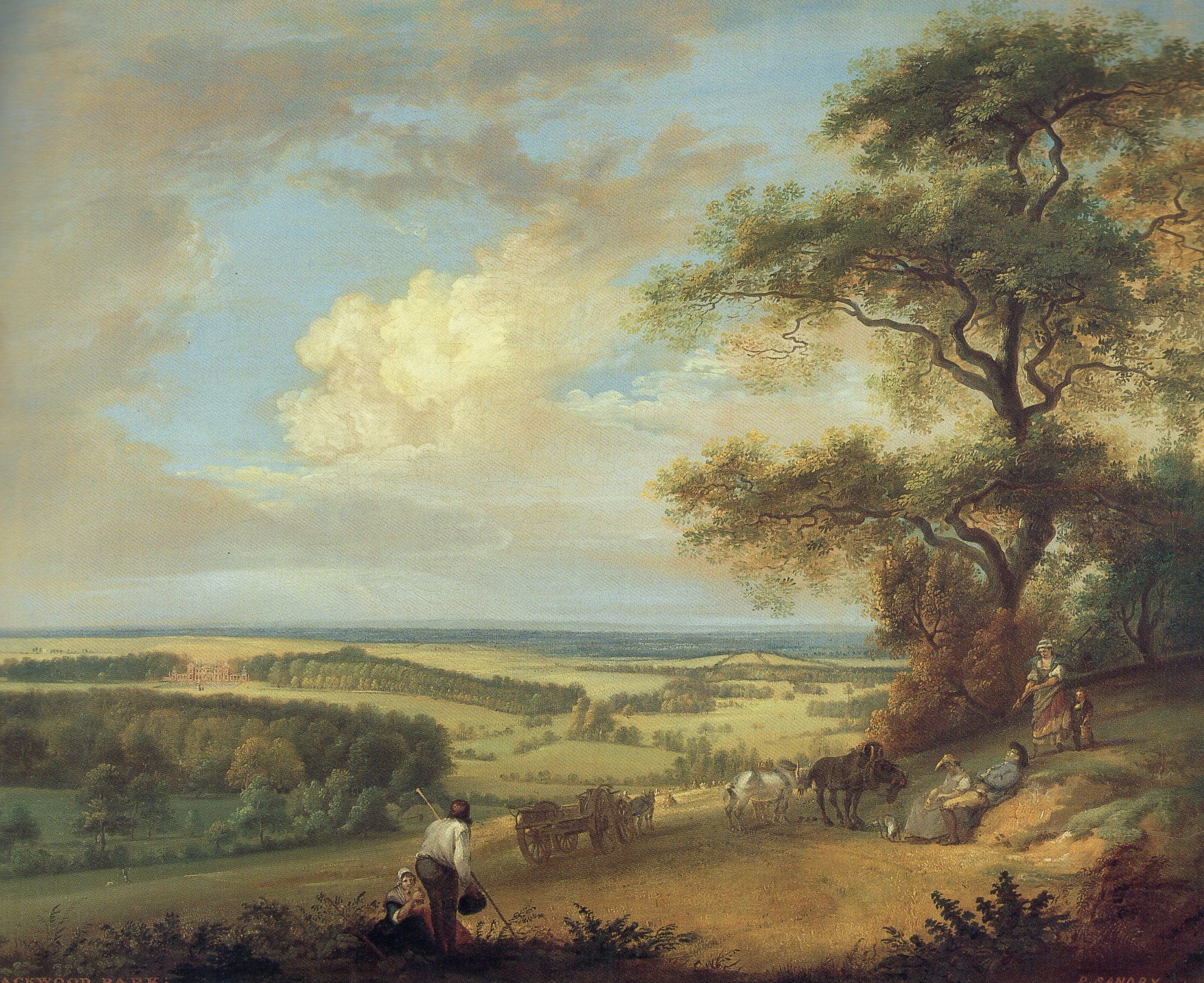
Hackwood Park, Hampshire (1763)
Oil on canvas (102 x 127 cm)
Yale Center for British Art
To enlarge the picture, right-click on it and “Open in a new tab”
The text of this post was written by the British art historian Malcolm John Warner for the catalogue of the exhibition “This Other Eden: British Paintings from the Paul Mellon Collection at Yale”, which toured Australia between May and November 1998
“Hackwood Park stands to the south of Basingstoke, and the view here is from the southeast. Built by the 1st Duke of Bolton in 1683-87, the house appears in the distance to the left, small but crisply rendered, with its statue of George I (a royal gift to the 3rd Duke, showing the king as a Roman emperor on horseback) visible in front. The painting was commissioned by Charles, 5th Duke, who held the title from 1758 until his untimely death, by his own hand, in 1765. The Duke’s architect, John Vardy, had been making improvements to the house, altering the south front in particular, and the view may have been painted as a record and celebration of these; perhaps there were changes in the surrounding park also. It was probably Vardy who suggested Paul Sandby for the commission. Around the same time, Sandby painted a larger view of another of the Duke of Bolton’s properties: Bolton Park in Yorkshire. and the two canvases in all likelihood hung as decorations in the Duke’s London house at 37 Grosvenor Square, where Vardy was also in charge of some improvements.
The painting gives remarkably little idea of the best-known feature of Hackwood Park, which is the large classical garden created around the house by the first three Dukes of Bolton. This was laid out on French lines, with a geometric pattern of avenues, canals and basins, as well as classical pavilions designed by James Gibbs. Sandby has taken his view from such a distance that we see nothing from all this but the parterre to the south of the house and the evenly planted row of trees along an avenue leading away to the east. Clearly, it pleased the 5th Duke to regard the setting of his house as rustic rather than formal, and his choice bears witness to a general shift of taste around his time, the beginnings of the “picturesque” movement. in this respect, the work stands in striking contrast to Siberechts’s view of Wollaton Hall (see A Prospect) where the park is marked off from nature rather than integrated. The delight in the rough informality of the country carries over into the comic depiction of the farm workers and horses in the foreground, who are taking their midday rest during the wheat harvesting.” (“This Other Eden”, p. 76)
 Old Masters