
RICHARD WILSON (1714-1782)
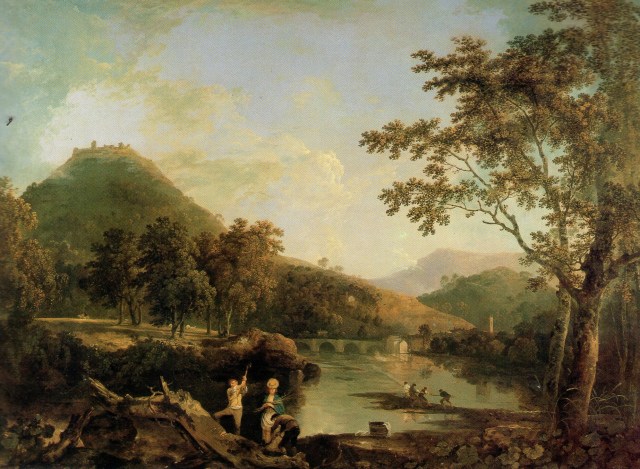
Dinas Bran from Llangollen (1770-71)
Oil on canvas (180 x 245 cm)
Yale Center for British Art
To enlarge the picture, right-click on it and then “Open in a new tab”
The following text has been taken from the catalogue written by Malcolm John Warner for the exhibition “This Other Eden: British Paintings from the Collection of Paul Mellon at Yale” which toured Australia between May and November 1998.
“Dinas Bran is an ancient fortress that occupies the top of a steeply conical hill of slate in the valley of the river Dee in Wales, on the estate of the Myddelton family of nearby Chirk Castle. The origins of the name Dinas Bran are obscure, but it has commonly been anglicized as “Crow Castle”. The present view is looking up the valley from the east, showing the hill higher than actually is, looming majestically over the small town of Llangollen with its 14th-century bridge. Wilson carefully places some trees in the right foreground as a pictorial counterweight to the hill and composes his scene generally to suggest a world of easy balance and harmony, both within nature and between nature and man.
The work is the complementary pair to a view along the valley from the other direction, looking down from a hilltop, with the distinctive form of Dinas Bran in the far distance. Both were commissioned from Wilson by a fellow Welshman, the young Sir Watkin Williams-Wynn, Bart., one of the richest men in Britain. Sir Watkin made his Grand Tour in 1768-69 and probably gave Wilson the commission just after coming of age in 1769. He would also employ Joshua Reynolds to paint family portraits and Paul Sandby to accompany him on a sketching tour of north Wales and indeed was one of the most generous British patrons and collectors of the 1770s and 1780s. The countryside shown in Wilson’s paintings was part of his homeland and the more distant view of Dinas Bran is taken from a point on his family estate of Wynnstay. The pair was later recorded as hanging at Sir Watkin’s London residence, 20 St. Jame’s Square, which was built for him by Robert Adam in 1771-74, and in all likelihood, this was the purpose for which they were painted, they served as proud reminders for Sir Watkin when he was in town, as well as for his visitors, of his place in the country and his Welsh origins. He was to make Welshness a key part of his persona and cherished the idea – which may or may not have any real genealogical basis – that he was a descendant from Rhodri Mawr, a king of Wales in the 9th century. He was also involved in societies for the revival and promotion of Celtic traditions. The wild, rugged appearance of Dinas Bran perfectly suited current ideas of the Celtic spirit. All important, it dated before the English subjugation of Wales in the later 13th century. There seems little doubt that, for patron and painter alike, it stood not merely as a local landmark, but as a symbol of national identity.”
 Old Masters