
JAN DAVIDSZ. DE HEEM (1606-1684)
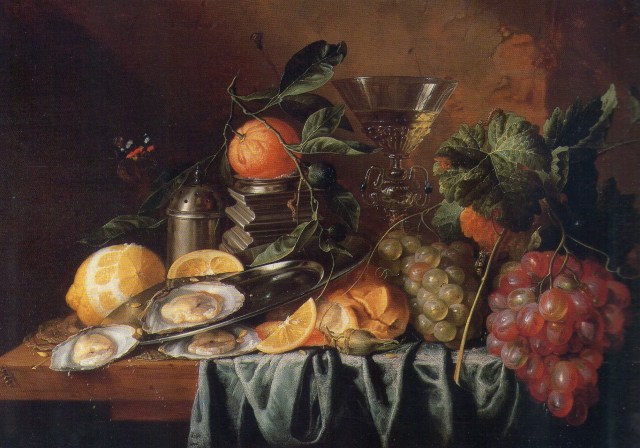
Still Life with Oysters and Grapes (1653)
Oil on wood (36 x 53 cm)
Los Angeles County Museum of Art
To enlarge the picture, right-click on it and open it in a new tab
The following text has been taken from the entry written by Richard Rand for the catalogue of the exhibition “The Ahmanson Gifts: European Masterpieces in the Collection of the Los Angeles County Museum of Art”. The footnotes are mine.
In 17th century Holland’s still-life was one of the most popular categories of painting. Various artists specialized in its different forms: vases of flowers, Vanitas (1), breakfast settings, trompe l’oeil (2), and pronkstilleven (ostentatious still life). For the sheer variety and ambition of his oeuvre de Heem is considered the greatest still-life painter of the period. He was born in Utrecht but early in his career moved to Leiden, where his paintings were influenced by the still-lifes of Balthasar van der Ast. By 1636 he had established a studio in Antwerp, the leading artistic centre of Flanders. De Heem is known to have returned to his native city several times; between 1669 and 1672 he is listed as a member of the Utrecht guild. Around 1673 he moved again to Antwerp where he lived out the rest of his life.
Still-Life with Oysters and Grapes, which is in an extraordinarily good state of conservation, was painted during de Heem’s first Antwerp period and is a fascinating synthesis of his early Dutch and subsequent Flemish painting styles. Its deceptively simple composition, with the props arranged on a rough-hewn table placed before a cracked and pitted wall, recalls the still-lifes of Claesz, who had earlier brought his sober and restrained style to a supreme degree of perfection in such works as Still-Life with Herring, Wine, and Bread (Los Angeles, Mr and Mrs Edward W Carter’s Collection). As Claesz did in his picture, de Heem used a simple diagonal (rising in this case from the lower left to the centre right) to organize the seeming disarray of his composition. Within this austere arrangement, however, he painted a great variety of objects, and the density of the composition and the superb handling of the paint are of a piece with his large-scale banquet table pictures.
A large number of elements, from luminous grapes, succulent oysters and a fresh hazelnut to a pewter saltcellar, crystal wine glass, and coarse cloth, are placed at eye level close to the picture plane, inviting the viewer to marvel at de Heem’s mastery in the depiction of contrasting textures and reflected light. The drops of water that roll off the oyster shells and the ants scurrying over the grapes are common trompe d’oeil devices. De Heem made the illusion complete by painting the corner of the background wall out of focus, thereby creating a startling leap in space from the crystalline clarity of the grape leaves in the foreground
The convincing realism and technical virtuosity of Still-Life with Oysters and Grapes would certainly have been enough to appeal to the tastes of a cultivated 17th-century art lover. Dutch and Flemish still-lifes, however, originally were understood to contain moralizing messages as well. The paintings held hidden meanings beneath the superficial beauty of the objects depicted. De Heem’s painting warns of the impermanence of natural beauty and the vanity of pursuing earthly pleasures; the fruit, after all, will decay (one leaf is beginning to turn), the ants will eat the grapes, and the oysters will spoil. The transient nature of life is symbolized by the caterpillars, which will metamorphose into butterflies, like the one at left. Not all the objects in the work caution against worldly indulgence, however; some testify to the enduring role of the Reformed Church in combatting hedonism and materialism. According to the Catholic Church, the inclusion of the prominent wine glass and bread in the centre of the picture is a reminder of God’s saving grace through the Eucharist (3).
(1) Vanitas is a word from the Latin meaning “vanity” and it gave its name to a particular genre of paintings whose purpose was to show the transience of life and the certainty of death. A form of art loved and encouraged by the miserable, pleasure-hating, Protestant religious fanatics.
(2) Trompe l’oeil is a French expression that means “fooling/deceiving the eye”. Basically, it is an optical illusion that tricks the viewer into perceiving painted objects or spaces as real by a highly skilful use of perspective and a brilliant technique.
(3) Eucharist is a word derived from the Greek eukharistia “thanksgiving, gratitude,” Christians believe that the rite was instituted by Jesus at the so-called “last supper” the night before his crucifixion, giving his disciples bread and wine. According to Christians the bread and wine represent the body and the blood of Jesus which are present/symbolised in the wafer given during the celebration of the Eucharist.
 Old Masters