
PIERRE LE GROS THE YOUNGER (1666-1719)
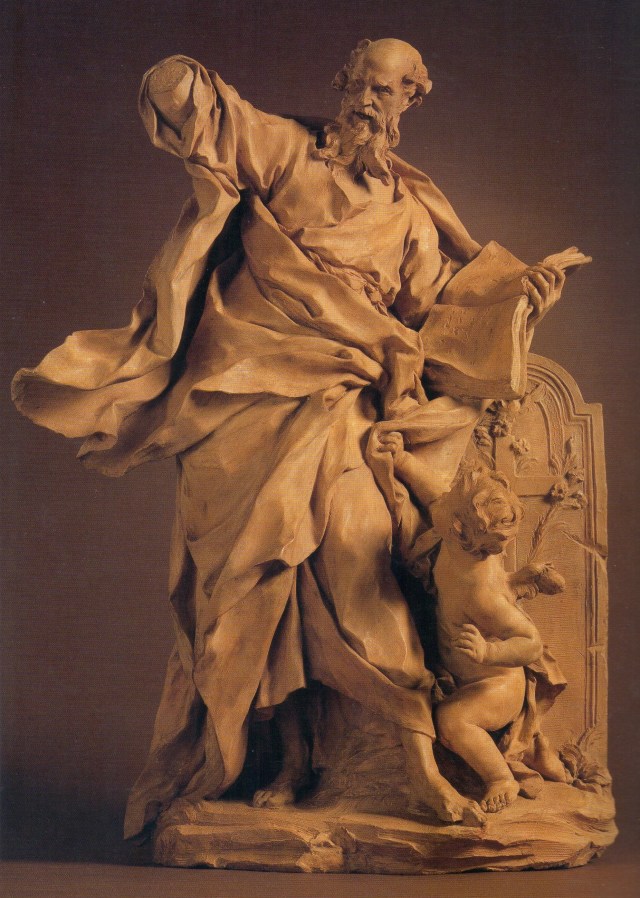
Saint Thomas (1703-05)
Terracotta (70 x 47 x 27 cm)
Los Angeles County Museum of Art
To enlarge the picture, right-click on it and open it in a new tab
The following entry/article belongs to the catalogue of the exhibition “The Ahmanson Gifts: European Masterpieces from the Collection of the Los Angeles County Museum of Art”.
“This terracotta is a model for the gigantic (over 4.5 metres high) marble Saint Thomas, one of a series of twelve sculptures of the apostles commissioned to fill the tabernacles built in the mid-17th century down the nave of San Giovanni in Laterano in Rome. The Lateran, one of Rome’s oldest, largest and most venerated churches, is the cathedral of the Pope in his capacity as bishop of Rome.
By the 17th century, the Constantinian basilica of Lateran had decayed into a seriously dilapidated state. In 1646, with the Jubilee year of 1650 approaching, Pope Innocent X ordered Francesco Borromini to renovate the church. The great architect devised a scheme in which alternating pairs of the numerous small piers of the early church were encased in what became enormous niches in a massively articulated arcade leading down the nave. In this way, much of the fabric of the old church was disguised but not destroyed. The niches were designed in white and multicoloured marble, their pediments bulging out from the plane of the arcade, with multiple sculptural effects to be achieved through variegated architectural profiles, decorative relief carving and monumental statues in the niches.
The statues of the apostles were not, however, carried out until half a century after the Jubilee. In 1699 Cardinal Benedetto Pamphili was named archpriest of the Lateran; the following year his friend Clement XI was elected Pope. The cardinal, a connoisseur of the arts, supported by the Pope, set about seeing the work in the Lateran to completion. The expensive, colossal sculptures, each to be carved out of a single block of marble, were subsidized by an international subscription. The king of Portugal, Pedro II, paid for the statue of Saint Thomas, the apostle who is said to have brought Christianity to Portuguese India. The commission was awarded to Pierre Le Gros “The Younger”, a French artist who found himself, even as a student at the French Academy in Rome, celebrated as one of the greatest sculptors in the Eternal City.
Le Gros, son of a sculptor, was also trained in design by his uncle, the engraver Jean Lepautre. In 1690 the Marquis de Louvois, sent Le Gros to study at the French Academy in Rome. Supported by a royal stipend, the artist was supposed to have worked exclusively for the Crown, but instead, he surreptitiously competed for and won, the commission for a multifigured group in marble, Religion Casting Down Heresy, for the chapel of Saint Ignatius Loyola in the Jesuits’ church of Il Gesu. This sculpture, in its asymmetry and turbulence, differed considerably from the grand, unified character of the baroque of the preceding century. Le Gros went on to win the competition for the central figure of this chapel, the huge silver statue of Saint Ignatius (destroyed in 1798). His other great commissions, the altar of Saint Luigi Gonzaga in Sant’ Ignazio and the San Filippo Neri in San Girolamo della Caritá, share a theatrical animation and fanciful style that herald the fantasy of the rococo.
The terracotta Saint Thomas is understandably more animated than the monumental marble that was realized from it. Le Gros’s predilection for complex groupings is manifested in the little angel crouching beside the apostle in the terracotta model (omitted from the marble). The slab with the cross, a symbol of the divine palace built by Saint Thomas that was revealed to King Gundaphous of India in a dream, is treated more decoratively in the terracotta. The book, the symbol of the apostolic message, has been replaced in the marble by the architect’s rule. In the terracotta the figure of Saint Thomas twists more dynamically, the facial expression is more intense, and the rendering of creases and folds is accomplished with a driving force that makes the whole composition unfurl like a banner in the wind.”
 Old Masters