
MATTIA PRETI (IL CAVALIERE CALABRESE) 1613-1699
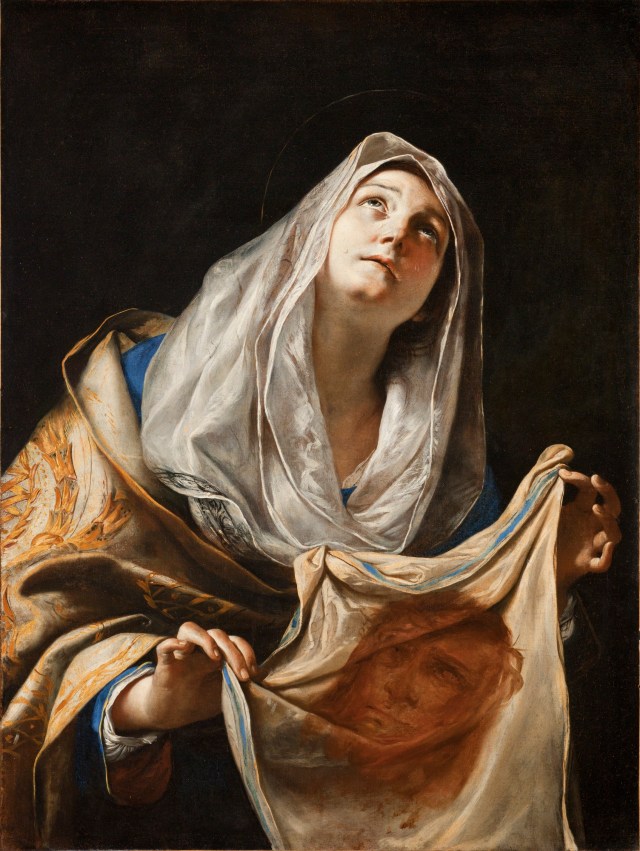
Saint Veronica with the Veil (c. 1655-60)
Oil on canvas (100 x 75 cm)
Los Angeles County Museum of Art
To enlarge the image, right-click on it and then “Open in a new tab”
The text that follows belongs to the entry written by Richard Rand for the catalogue of the exhibition “The Ahmanson Gifts” organized by the Los Angeles County Museum of Art (LACMA) in 1991. The notes are mine.
“Preti was born in Calabria, a province of the kingdom of Naples, hence his nickname (1). His early training is unknown, but apparently, by 1630 he was already an established painter. That year he set up a studio in Rome with his older brother, Gregorio. In Rome, Preti studied the art of Guercino and Caravaggio, which was to have a decisive impact on the development of his style. He travelled widely, to Florence, Bologna, and Venice, but remained based in Rome; there he painted a fresco cycle of the life of Saint Andrew in the church of Sant’ Andrea della Valle. In 1653 he was elected to the Academy of St. Luke.
The next two years were spent in Modena, after which Preti went to Naples, where he remained until 1661. In the 17th century, Naples was a dominion of the Spanish Hapsburgs and a major centre of the Counter-Reformation. It hosted a vital community of artists as well. These local artists, organized into the Corporazione dei pittore napoletani were often hostile to outside painters, and Preti was no exception. In the year he arrived, however, Naples was in the throes of a devastating plague that claimed the lives of more than half of its population, including some of the finest local painters. Preti soon found himself the leading artist in town and over the course of four years received numerous private and public commissions.
Preti’s moving Saint Veronica with the Veil was probably painted during his Neapolitan sojourn. It conforms to the manner he adopted in response to painters such as Jusepe Ribera and Giovanni Battista Caracciolo, who had based their art on Caravaggio’s stark realism and dramatic treatment of light and shade. Like Preti’s full-length Saint Sebastian (Museo di Capodimonte, Naples) painted in 1657 for the church of San Sebastiano, Saint Veronica presents its subject before a dark background, theatrically illuminated from above. The effect gives the saint a formidable presence as she seemingly emerges from the canvas to present the sudarium (2) to the viewer. Veronica gazes heavenward, tears rolling softly down her cheeks, as she acknowledges the divine source that illuminates her.
Veronica was one of the holy women who accompanied Christ to Calvary. She wiped his brow with her veil, which became miraculously imprinted with his image. According to a legend, Veronica took her veil to Rome where it cured the Emperor Tiberius of an illness. Consequently, the saint’s cult was very strong in Rome, her veil and subsequent representations of it were worshipped for their healing powers. The veil had a special meaning for artists as well since it was considered to represent the true image of Christ’s likeness; in fact, the saint’s name derives from the Latin vera icon (3)
Although images of Saint Veronica were relatively scarce in the 17th century, Preti followed the accepted manner of depicting Christ’s face in reddish brown tones, like a Byzantine icon Jesus stares at the viewer from the folds of the cloth, the crown of thorns visible around his brow. The small scale of the picture and, for Preti, its unusually subdued and meditative qualities indicate that the painting was intended for private devotion.”
(1) The Italian word “cavaliere” means “knight”. Mattia Preti, like many other famous Italian artists, received a knighthood from the Catholic Church as a reward for his services; in his case the honour was bestowed on him in 1659 by the Sovereign Military Order of St. John of Jerusalem, better known as the Order of Malta.
(2) The Latin word “sudarium” describes a cloth used to wipe the sweat from one’s face; it derives from the Latin and Italian verb “sudare” (to sweat).
(3) The name Veronica has Latin and Greek roots: “vera” (true) and “eikon” (image). The word “icon” is just the Latin form of “eikon” and usually applies to religious images
 Old Masters