
LOUIS GABRIEL BLANCHET (1705-1772)
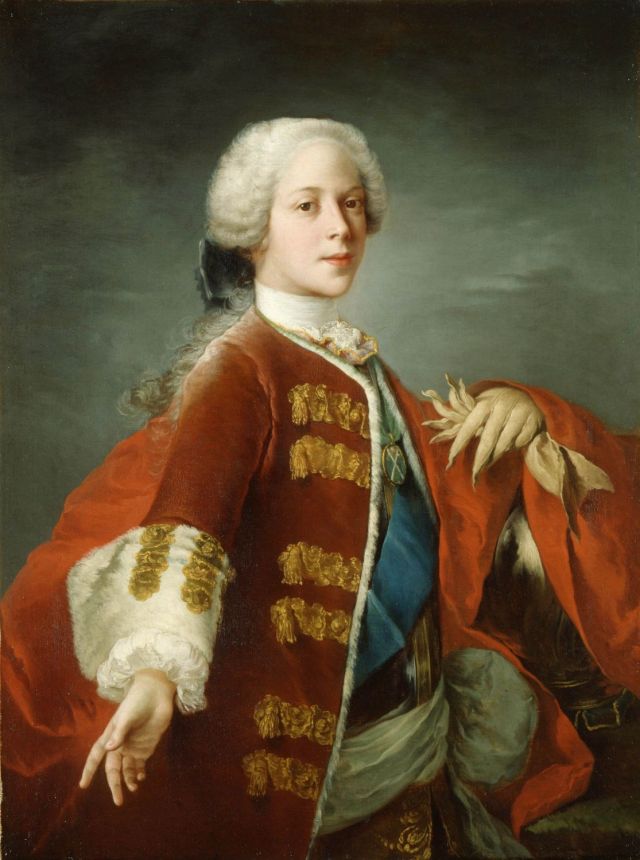
Prince Henry Benedict Stuart (c.1739)
Oil on canvas (98 x 73 cm)
Palace of Holyroodhouse, Edinburgh, Royal Collection
To enlarge the picture, right-click on it and “open in a new tab”
This beautiful portrait and its pair, the one of his older brother Prince Charles Edward Stuart, are arguably Blanchet’s most memorable works. They combine impeccable draughtsmanship with a vivid sense of colour and a lively characterization. They were part of a group of four portraits, the other pair depicting the brothers’ parents which was commissioned by William Hay, the Young Pretender’s Groom of the Bedchamber and were sent from Rome to Scotland in 1741, via James Edgar the Prince’s secretary. This portrait and its pair were acquired from Hay’s descendants by Queen Elizabeth II in 1966.
Painted when Henry was 14 years old, the portrait shows him as a high-ranking nobleman, as he was. He is wearing the medal of the Order of the Thistle which was created in 1687 by James VII, King of Scotland, who claimed he was reviving an existing, ancient order although there is no conclusive evidence to support this. Blanchet chose to depict Henry as a potential military leader, as every nobleman was at that time, by showing him wearing a cuirass; his left arm is resting on what seems to be another piece of armour.
Although it may seem strange, I could not find any information about Louis-Gabriel Blanchet from French sources; in fact, to my surprise, there is even no article about him on the French version of Wikipedia. The information I present here comes from an excellent and extensive entry written by Professor Domenico Giampa about a portrait of Count D’Angiviller by Blanchet offered by the Milanese art dealer Roberto Caiati.
In 1727, at the age of 25, Louis-Gabriel Blanchet was one of the winners of the Prix de Rome, the prestigious award given every year by the French Royal Academy of Painting and Sculpture to the best ten students (6 painters and 4 sculptors). The prize consisted of a three to five-year stay in the French Academy in Rome at the expense of the King of France. Blanchet arrived in Rome in 1728 and never returned to France, dying there 44 years later. In 1736 he painted the splendid portrait of Giovanni Paolo Panini, who was a professor at the Academy of St. Luke and who would later become his father-in-law. In 1738 he began a series of portraits of the exiled Stuarts that would continue into the 1740s. Between 1737 and 1749 Blanchet was one of the French artists commissioned to paint copies of the famous frescos by Rapahel that decorate the Vatican palace’s rooms. Blanchet dedicated the last twenty years of his life to portraiture; despite the presence of brilliant competitors such as Pompeo Batoni and Anton Raphael Mengs, he was a very successful and popular portraitist.
Henry Benedict Stuart, Cardinal Duke of York (1725-1807) was brought up in Rome at the court of his father, the exiled Prince James Edward Francis Stuart (the “Old Pretender”) Henry went to France in 1745 to help his brother Charles Edward’s return to Scotland to claim the crowns of England, Ireland and Scotland. After the disaster of Culloden and the failure of the uprising, Henry returned to Italy. On 30 June 1747 Pope Benedict XIV created him cardinal-deacon (the lowest rank in the hierarchy of the cardinalate) He was ordered priest on 1 September 1748 and consecrated archbishop of Corinth on 2 October 1758.
According to the historian James Lees-Milne: “His revenues from the ecclesiastical appointments he enjoyed were enormous. His income from abbeys and other pluralities in Flanders, Spain, France and Naples amounted to £ 40.000 a year (1) He also held sinecure benefits yielding great revenues in Spanish America, he even owned property in Mexico which contributed largely to his income. The Pope held him in great esteem and awarded him numerous honours and titles. He was made cardinal-bishop of Frascati on 13 July 1761 and eventually succeeded to the See of Ostia and Veletri on his appointment as dean of the Sacred College of Cardinals on 26 September 1803″ (“The last Stuarts: British Royalty in Exile”, 1983)
As a consequence of the French Revolution, Henry lost his prebends from France since the French government confiscated all Church property. The invasion of Italy by the revolutionary army under the young Bonaparte brought him further cause of anxiety as his properties there were also confiscated. Having lost most of the properties that provided him with a huge income, Henry fell on hard times and it was thanks to the British minister in Venice that he was awarded an annuity of 4000 pounds from King George III; although the British government regarded this generous gesture as an act of charity (as indeed it was), Henry and the Jacobites considered it as the first instalment of the money which was legally owed to him (the reason behind this belief was the promise made by the British government that it would return the English dowry of Henry’s grandmother, Mary of Modena, but it never did so)
Henry was never interested in his family’s claim to the thrones of England, Ireland and Scotland. He returned to Frascati in 1803, in September of the year he was made dean of the College of Cardinals and hence cardinal-bishop of Ostia and Veletri. He lived in the episcopal palace of Frascati where he died on 13 July 1807 aged 82.
(1) To give the reader an idea of the approximate value of £40.000 in 1760 in today’s money, let’s say that it would be worth £93.570.000 (The source is the excellent website Measuring Worth whose link is here: https://www.measuringworth.com/calculators/ukcompare/relativevalue.php
 Old Masters