
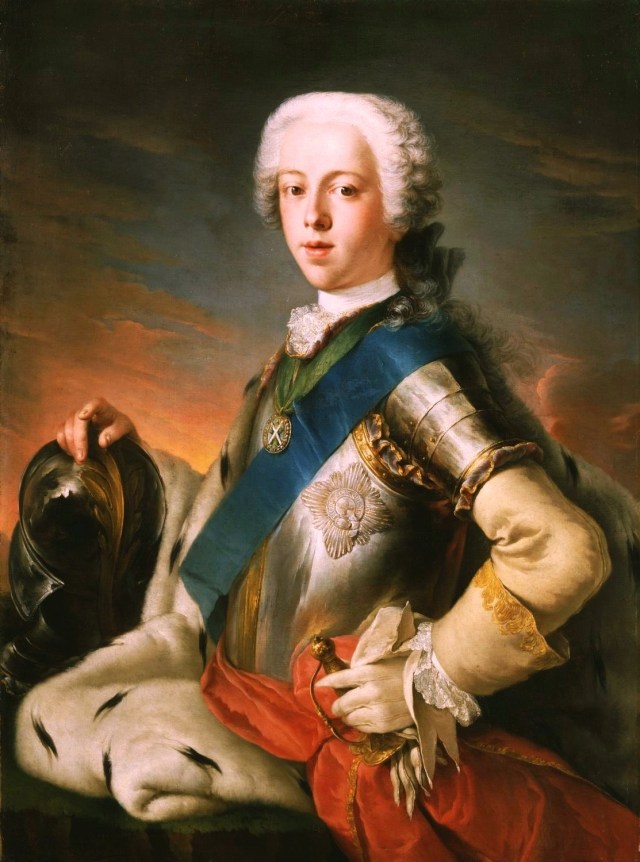
LOUIS GABRIEL BLANCHET (1705-1772)
Prince Charles Edward Stuart (1737-38)
Oil on canvas (98 x 75.5 cm)
Palace of Holyroodhouse, Edinburgh, Royal Collection
To enlarge the picture, right-click on it and “Open in a new tab”
Very little is known about Louis Gabriel Blanchet, a gifted portraitist who spent his professional career in Rome. He was born in Paris in 1705, we do not know who were his teachers but he obviously showed great promise winning second place in the Prix de Rome competition of 1727, thereafter he settled in Rome where he enjoyed the patronage of Nicolas Vleughels, Director of the French Academy and the Duke of Saint-Aignan who was at that time ambassador to the Holy See.
In 1752 Blanchet painted a Vision of Constantine (Paris, Louvre) a copy of Giulio Romano’s fresco in the Sala di Constantino in the Vatican. However, he was primarily a portrait painter; his portrait of Tolozan de Montfort (1756, Lyon, Musee des Beaux-Arts) is a fine example of his distinctive, elegant style and rich sense of colour. Other surviving works of his include Giovanni Paolo Panini (1736, Sotheby’s), Saint Paul (1751, Avignon, Musee Calvet), Charles-Claude Fahault de La Billarderie (1765, Sotheby’s) and his full-length portrait of P. P. Leseur and E. Jacquier (1772, Nantes, Musee des Beaux-Arts).
The portrait of Prince Charles Edward Stuart (1720-1788) was painted when the sitter was eighteen-years-old. He is depicted as a young warrior wearing the archaic conventional parade armour worn only in portraits of a military character. He wears the Order of the Garter and the Order of the Thistle. As a symbol of his regal condition, he is wearing over his right shoulder a cloak of ermine. Blanchet sense of colour and light is exquisite; the light coming from the left illuminates the young prince’s face and reflects on his armour.
The portraits of the Stuart brothers painted by Louis-Gabriel Blanchet are among the finest he ever produced. Like almost all talented portrait painters, some of his works were much better than others and the Stuart portraits belong to that category.
Charles Edward Stuart was born in the Palazzo Muti in Rome, on 31 December 1720, the palazzo had been given to his father by Pope Clement XI who supported the cause of the Stuart dynasty looking forward to a possible restoration of the Catholic faith in Britain. He was the elder son of James Francis Edward Stuart, known as “the Old Pretender”. His grandfather was the last Stuart sovereign, James II of England and Ireland and VII of Scotland, who was betrayed and brought down by the nobility in the so-called “Glorious Revolution of 1688”.
In December 1743, Charles’s father named him Prince Regent, giving him authority to act in his name. Eighteen months later, he led a French-backed rebellion intended to place his father on the thrones of England and Scotland. Charles purchased and equipped two ships and on 23 July 1745, he landed on Scottish soil. Charles had been expecting support from the French fleet but this had been badly damaged by storms and he was left alone to raise an army.
The Jacobite cause was still supported by many Highland clans both Catholic and Protestant. Charles had expected a warm welcome from these clans to start a Jacobite insurgency. He raised his father’s standard at Glenfinnan and gathered a force large enough to enable him to march against Edinburgh. On 21 September 1745, he defeated the only government army in Scotland at the battle of Prestonpans. By November Charles was marching south at the head of a small army of 6000 men. On the 4th his troops entered Derby 120 miles north of London but rather than push on to the ultimate prize he yielded to his generals, who at a war council decided that considering the lack of English support to the cause of the Stuart, it was better to go back to Scotland. The Jacobite army began its march north, followed by the English army commanded by George II’s son the Duke of Cumberland.
On 16 April 1746, both armies clashed at Culloden. Against the advice of his generals, Charles decided to attack the English. The Scottish troops were massacred by the English artillery and the disciplined volleys of the infantry. The Scottish army broke and fled, chased by the English who murdered the wounded. Charles meanwhile, had left the field believing that his swift return to France would allow him to raise the French battalions needed to resurrect the campaign. Others, however, believed that he had abandoned the troops to their terrible fate and even abandoned the Jacobite cause in order to save his own skin. In the event, Charles spent five months as a fugitive in the western Highlands with Cumberland troops in relentless pursuit. He eventually fled to France thanks to the selfless help of the heroic Flora MacDonald., and died in Rome in 1788, by all accounts a drink-befuddled and bitter man. Like many other men in his position, Charles Edward Stuart demonstrated he was not up to the task he began; considering his behaviour at Culloden and after, he was weak and very likely a coward .
 Old Masters