
AUGUSTIN PAJOU (1730-1809)
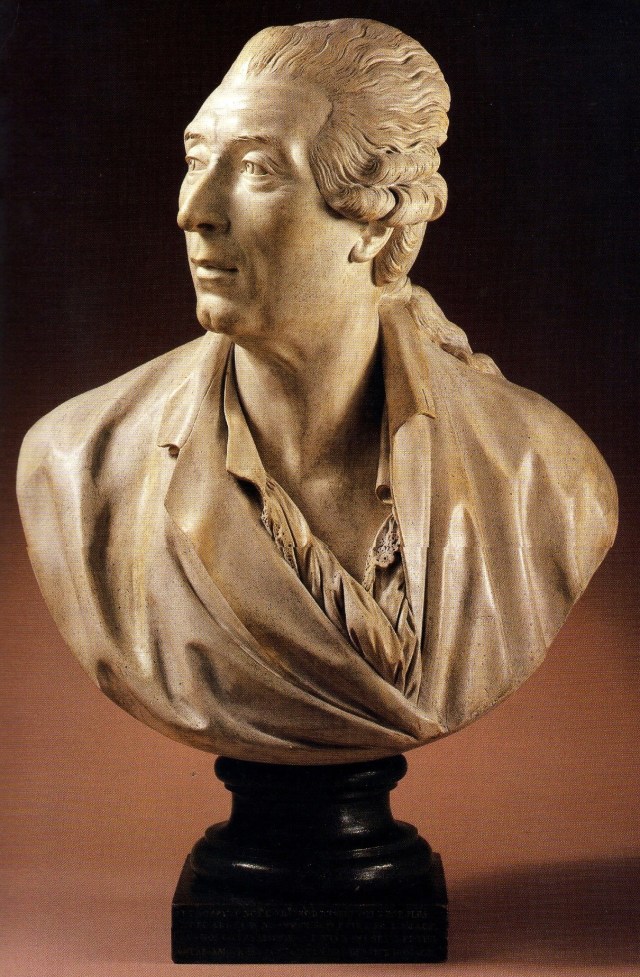
Portrait of Jean-Sylvain Bailly (1791)
Patinated plaster (75 x 49 x 28 cm)
Los Angeles County Museum of Art
To enlarge the picture, right-click on it and “Open in a new tab”
Jean-Sylvain Bailly (1736-93), whose literary career was surpassed by his studies in astronomy and its history, was elected to the French Academy of Sciences at the age of twenty-seven. Born in Paris Bailly was the son of Jacques Bailly, an artist and supervisor of the Louvre, and the grandson of Nicolas Bailly also an artist and a court painter. As a child, he originally intended to follow in his family’s footsteps and dedicate his life to the arts. However, he became deeply attracted to the sciences, especially astronomy. An excellent student “with a particularly retentive memory and an inexhaustible patience” he calculated an orbit for the next appearance of Halley’s comet (in 1759)
Bailly published his Essay on the Theory of the Satellites of Jupiter in 1766. The essay was an expansion of the presentation he had made at the Academy in 1763. He later released the noteworthy dissertation On the Inequalities of the Light of the Satellites of Jupiter in 1771. In 1778 he was elected a foreign member of the Royal Swedish Academy of Sciences.
Bailly gained a high literary reputation as a result of his Eulogies for King Charles V of France, Lacaille, Moliere, Pierre Corneille and Gottfried Leibnitz which were issued in collected form in 1770 and 1790. He was admitted to the Academie Francaise on 26 February 1784 and to the Academie des Inscriptions in 1785. From then on Bailly devoted himself to the history of science. He published A History of Ancient Astronomy in 1775, followed by A History of Modern Astronomy (3 vols. 1782) Other works include Discourse on the Origin of the Sciences and the Peoples of Asia (1777) and A Treatise of Indian and Oriental Astronomy (1787)
In the month leading up to the outbreak of the French Revolution, Bailly became involved in politics, he was deputy for the city of Paris and on 3 June 1789, he was elected inaugural President of the National Assembly. In the aftermath of the storming of the Bastille, Bailly was appointed mayor of Paris, as such, he dealt efficiently with the shortage of food that threatened the revolutionary government. After the failed attempt by the royal family to flee the country, Bailly tried to contain the crowds asking for King to step down. On July 1791 Bailly heard of a gathering at the Champ of Mars, where citizens were meeting to sign a petition calling for the overthrow of the King. Bailly sent troops from the National Guard to disperse the riotous assembly, there was a fight and many lives were lost. Public opinion blamed this on Bailly and Lafayette; having become extremely unpopular Bailly resigned on November 12 and retired to Nantes. In July 1793 he was arrested and pressed to testify against Marie Antoinette, he refused and was brought before the Revolutionary Tribunal that condemned him to death. On 12 November 1793 Bailly was guillotined. He was one of the many innocent victims of the blood-thirsty tyranny imposed by Robespierre.
Pajou, a descendant of a family of sculptors, studied under Jean-Baptiste Lemoyne and won, in 1748, the first Grand Prix de Sculpture. After spending four years at the French Academy in Rome (1752-56), he returned to Paris to embark on one of the most illustrious careers of any French sculptor in the second half of the 18th century.
In 1768 he was awarded the commission for all the sculptured ornament of the Opera at the chateau of Versailles. This ambitious undertaking involved the decoration of the exterior of the building, the sculpture for the foyer, and a multitude of reliefs and panels for all the loges of the interior. The Opera was to be ready in just two years for the marriage of the Dauphin Louis to Marie Antoinette of Austria. Pajou oversaw a team of practitioners who worked incessantly to complete the project by 1770. By then he had become the favourite portraitist of Madame du Barry and, after his nomination as sculpteur du Roi was made responsible, from 1777 to 1784 for the official portraits of Louis XVI.
Unlike Houdon, who was famous for the liveliness and the realism of his portraits , Pajou developed a more restrained style. In contrast with Houdon’s portrait of Bailly (c.1790 Lindenau Museum, Altenburg), Pajou idealized the features and further neutralized the details of contemporary costume, favouring, like Reynolds, a vaguely neo-classical type of garment.
 Old Masters