
FRANS HALS (1581/85-1666)
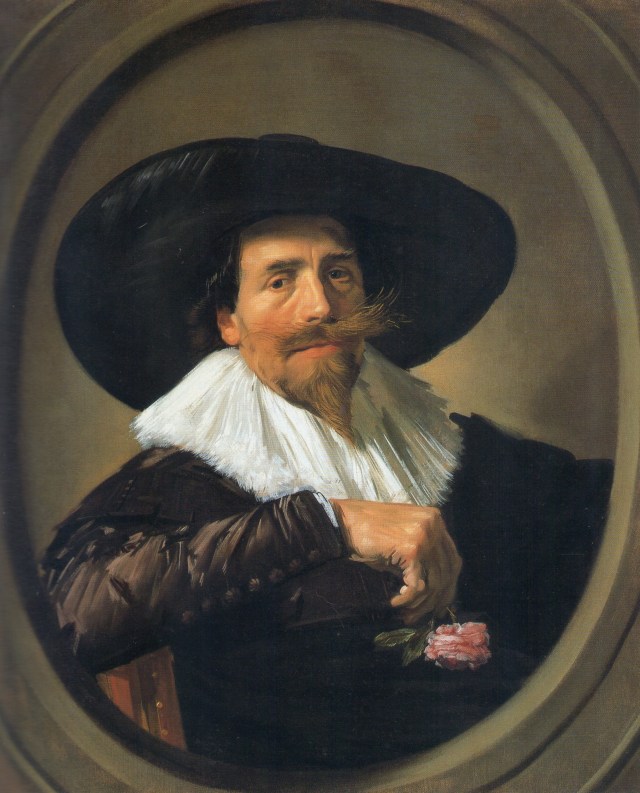
Portrait of a Man / Portrait of Pieter Tjarck (1635-38)
Oil on canvas (85 x 70 cm)
Los Angeles County Museum of Art
To enlarge the images, right-click on them and “Open in a new tab”
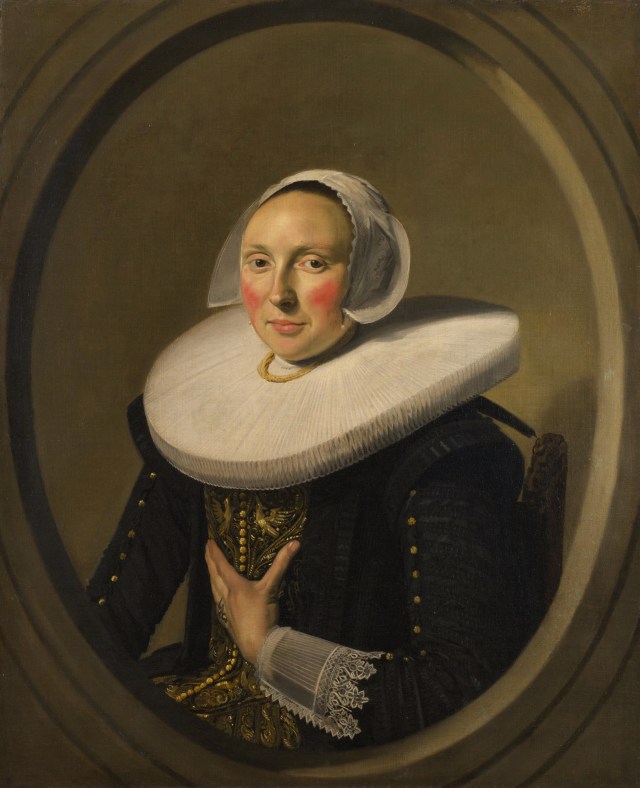
The identity of the sitter in this magnificent portrait has sometimes been questioned, but there seems to be no reason to doubt the veracity of its traditional identification. The painting first appeared at a Parisian auction in 1889 as a “Portrait of Messire Pierre Tiarck” An old label on the back of the panel bears an inscription, probably from the 18th century, which reads: “Messire Pierre Tiarck / fils de Theodore et de / Mademoiselle Gertrude / Worp” In the 1889 sale the painting was paired with a Hals portrait of a woman, which is now in the National Gallery, London. It too bears an inscription, apparently by the same hand, which describes the woman as “Mademoiselle Marie Larp fille / de Nicolas Larp et de / Mademoiselle de Wanemburg” Research in the Haarlem archives revealed several references to a Maria Claes Larp, who in 1634 married a Pieter Dircksz Tjarck, whose occupation was listed as a dyer of silk. Therefore it would appear completely reasonable to assume that the French inscriptions on the back of the two paintings were translations of the names of the sitters, taken either from old Dutch labels that have since been lost or based on some other source of information.
The portrayal of the sitters offers evidence that the two were painted as pendants. The pictures are nearly identical in size, and in each, the sitters are placed within painted oval frames and lit from the left. Within these points of similarity, however, Hals has varied the gestures and forms of the two sitters, contrasting the man’s casual air, his hand dangling a rose, with the woman’s tense, open hand held up to her breast. Regarding the latter, the gesture has several important and symbolic meanings; one of them is fidelity or loyalty in this case to her husband, but it also can be found in statues and portraits of noble men and women in the presence of a king or a queen. They bow and, at the same time, they place their right or left hand on their heart pledging their loyalty to the sovereign. It also means sincerity and honesty since it implies that my words or actions are dictated or motivated by my heart and, therefore, they are pure and genuine.
In traditional fashion, Tjarck and Larp are distinguished from each other by the way the artist reveals their personalities. The husband, with his tilted hat and air of bravado, challenges the viewer through the simulated frame surrounding the composition. As if interrupted, he turns towards the spectator, leaning his arm across the back of a chair. The effect is one of a fleeting moment captured in paint, of a dynamism and spontaneity that is contained in the very brushwork itself, with its flashes of highlight and quickness of touch. This transient, even casual, treatment of a portrait was a characteristic remarked upon by the artist’s early biographer, Arnold Houbraken, who wrote of “the boldness and vivacity with which his brush caught the natural likeness of human beings”
Hals adopted his technique in each portrait to reinforce the sitters’ different characters,. For his portrayal of Tjarck, Hals loaded his brush with paint, deftly describing the textures of the silken doublet and the linen ruff, the gleam of flesh and the stiff moustache. Tjarck’s hand and the rose it holds were painted with a startling palpability; they appear to break through the picture plane and enter the viewer’s space. When he created Larp’s portrait, however, Hals seems to have reined in his characteristic flamboyant handling of the paint, restraining his technique in keeping with the Puritan demeanour of his subject. Any insight Hals might have had into her personality appears subsumed within a concentrated effort in rendering her apparel: the exquisite quality of her lace cuff, the finely embroidered dress and the millstone ruff. Larp disappears behind an elegant facade, exuding none of the self-assurance of Tjarck.
Hals is considered today one of the greatest Dutch artists of the 17th century and perhaps its greatest portraitist after Rembrandt. However, he was virtually unknown outside Haarlem in his own time and, like Vermeer, was “rediscovered” only in the 19th century when Dutch art was reappraised by French critics and artists. As a result of his obscurity, very little is known of his life. He was born in Haarlem; there he probably studied with Carel van Mander, but he did not become a member of the artists’ guild until 1610. The entirety of Hals’ career was spent in Haarlem, where he received numerous portrait commissions from various militia companies as well as leading citizens. Despite his great productivity, Hals was continually in debt and he died in poverty in 1666.
 Old Masters