
ANTHONIS MOR / ANTON VAN DASHORST MOR (1518-1576)
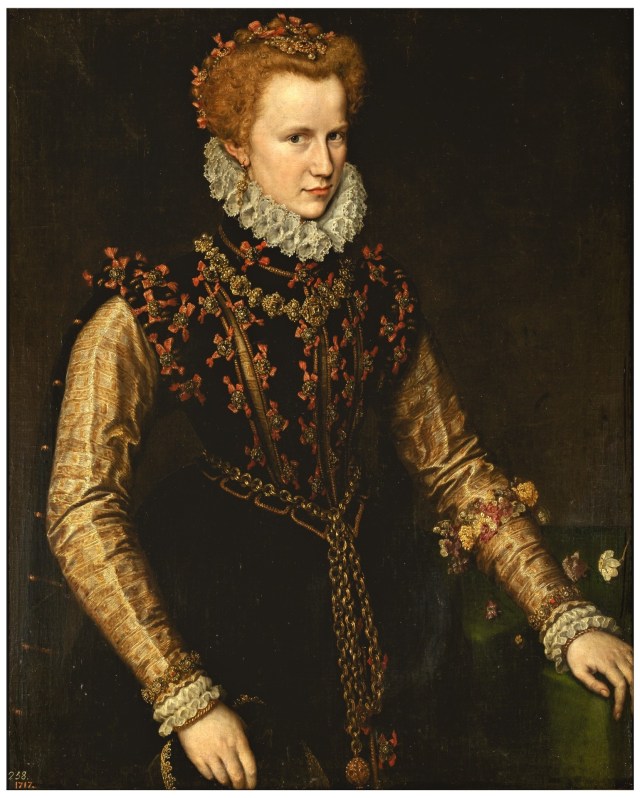
Jane Dormer, Duchess of Feria (c.1558)
Oil on canvas (95 x 76 cm)
Museo del Prado, Madrid
To enlarge the picture, right-click on it and “Open in a new tab”
Anthonis Mor (as he is most widely known) is not a name familiar to many Old Masters lovers and yet he was one of the most successful and sought-after portrait painters of the second half of the 16th century. His stern, highly detailed, likenesses remind us of Holbein the Younger. Born in Utrecht, he studied under Jan van Scorel and became his assistant towards 1540. According to Karel van Mander, Mor went to Italy where he remained for three years before returning to Utrecht. In 1547 he was admitted as a master by the Guild of St. Luke in Antwerp, but he returned to Utrecht where he got married and set up a studio. In 1548 he attracted the attention of an influential patron of the arts, Antoine Perrenot de Granville, bishop of Arras and member of the court of Emperor Charles V. His portrait of Cardinal Granville (Vienna, Kunsthistorisches Museum) and the one of the Duke of Alba (Hispanic Society, New York) showed already a new style that harmonized the crisp, detailed finish of the Northern school with the elegance of the Italian models. He was able to see the works from Tiziano in the collections of the cardinal Granville and Mary of Hungary, the regent of the Netherlands.
As Cardinal de Granville introduced him to the imperial court of Spain, he developed a new style of regal and courtly portraiture. The sitters would be depicted in three-quarters or full-length, illuminated by a subdued light coming from the left, the dark background, almost black, would offset the bodies. The jewellery and the garments were rendered with minute attention to detail. In the summer of 1550, the Regent of the Netherlands (Mary of Hungary) sent him to Lisbon to portray the Portuguese royal family, particularly Maria of Portugal, Felipe II’s fiancee. By July 1551 he was back in Spain where he portrayed the sister of Felipe II: Empress Maria of Austria, wife of Maximilian II (Museo del Prado). By the spring of 1552, he was back in Lisbon painting the portraits of members of the royal family and great courtiers. By that time the betrothal of Felipe II with Maria of Portugal had been cancelled in favour of his father’s nice and Queen of England, Mary Tudor. Mor was sent to London to paint the portrait of the wife of Felipe II, after their marriage in July 1554 (Museo del Prado)
In December 1554 Anthonis Mor was appointed Painter to the King and moved to the court at Brussels where he remained until 1559. During that time he portrayed William of Orange (Schloss Wilhelmshohe, Kassel), Alejandro Farnesio (Galeria Nazionale di Parma) and Felipe II at the battle of San Quintin (El Escorial). From 1561 to 1576 Mor spent his time travelling between Utrecht and Brussels, carrying out commissions from Cardinal de Granville and Margarita de Parma.; and from 1568 until 1572 working for the Duke of Alba, Governor of the Netherlands. In 1573 he moved to Antwerp where he spent his last years.
Jane Dormer (1538-1612) was a lady-in-waiting to Queen Mary I who, after the death of the Queen, married Don Gomez Suarez de Figueroa y Cordoba 1st Duke of Feria, and went to live in Spain. She was the daughter of Sir William Dormer of Wing, Buckinghamshire and Mary Sidney of Penshurst, Kent. Jane Dormer was born during the reign of Henry VIII when her family was split because of the controversy caused by the ongoing Reformation. On the one side, her father’s family remained staunchly Catholic; however, her mother’s family embraced Protestantism. Because of her mother’s early death in 1542, Jane was brought up by her paternal grandmother. As a result of that, she became a fervent Catholic. Jane’s faith and her royal connections would take her to the heart of power. Despite an age gap of nearly 20 years at the age of 16 Jane became one of Queen Mary’s closest friends and confidants. In 1558 she married Don Gómez de Figueroa y Córdoba, 1st Duke of Feria, a confidant of Felipe II and his first ambassador to Queen Elizabeth I’s court. When he was replaced in 1559 he and Jane returned to Spain where she became the rallying point for the exiled English Catholics. Despite her faith, she kept a correspondence with Queen Elizabeth I but she also kept in touch with numerous English Catholics. Her kind and generous nature made her a champion for all destitute English exiles. On her husband’s death in 1571, she took over the management of his estates. In 1609 Jane suffered an accident from which she never recovered; she fell and broke her left arm above the elbow. The bone never healed properly causing her a great deal of pain and suffering. By 1611 she became bedridden and died on 13 January 1612 surrounded by the affection and respect of all who knew her.
Anthonis Mor’s portrait shows Jane in all her finery befitting a lady of the highest rank. Every piece of jewellery is meticulously represented as the details of her ornate dress, particularly effective is the depiction of the shimmering gold brocade of her sleeves. It is very important to remember that, up to the end of the 18th century, the garments and the jewellery indicated clearly the rank and importance of the sitter, therefore portrait painters were expected to reproduce them faithfully. The garland of flowers around her left forearm may be an allusion to her marriage to Don Gómez de Figueroa y Córdoba or an allusion to the goddess Flora symbol of spring, fertility and renewal. Although her demeanour is quite stern there is a faint smile on her lips that betray a kind and gentle soul. In my opinion, this is one of the most moving and beautiful portraits of Mor
 Old Masters