
PETER PAUL RUBENS (1577-1640)
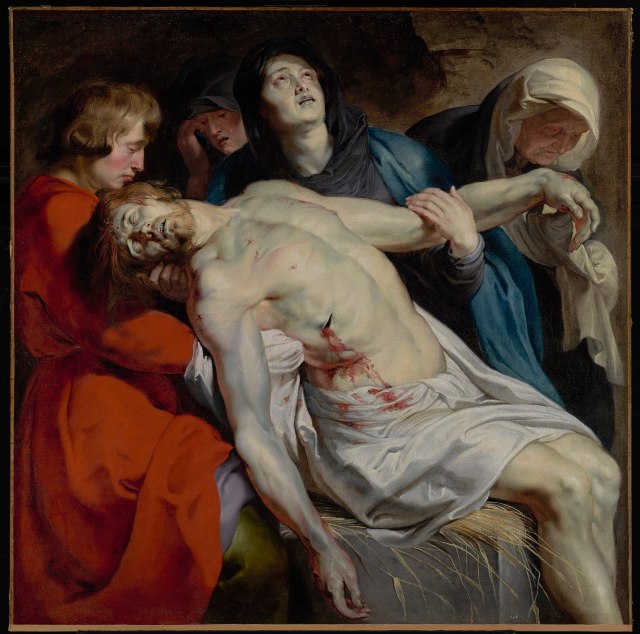
The Entombment (c.1612)
Oil on canvas (131 x 130 cm)
Paul Getty Museum, Los Angeles
To enlarge the picture, right-click on it and “Open in a new tab”
Recognized as the greatest painter of his day, Rubens received commissions from all over Europe and created profound, original statements of virtually every conceivable subject, Among his greatest contributions to Baroque art, were religious paintings that express emotion with an intensity that has never been surpassed.
This powerful painting was carefully composed to focus devotion to Jesus Christ’s sacrifice and suffering. The beautiful corpse is reverentially supported by those closest to him in life. At left is John the Evangelist. Mary Magdalene weeps in the background as her constant companion. Mary, the mother of James the Younger and Joseph, contemplate Christ’s wounded hand at right. The viewer is compelled to join the mourners, whose grief is focused on the Virgin Mary, weeping as she implores heaven (obviously, she was unaware that all this was part of God’s brilliant plan)
Rubens was a devout Catholic, and his paintings give tangible form to the main concerns of his religion. To make the religious experience more personally resonant, art followed contemporary meditation, which encouraged the faithful to imagine the physical horror of Christ’s crucifixion. Here, the head of Christ, frozen in the agony of death, is turned to confront the spectator directly. Ruben also compels us to regard the gaping wound on Christ’s side, placing it at the exact centre of the canvas. The composition as a whole, as well as the drawing of the heroic musculature, conveys the languid quality of the subject.
The artist also adds a few symbolic elements to this standard scene of lamentation over the body of Christ. These additions reflect the theological and political concerns of the Counter-Reformation in the early 17th -century. Thus, the slab on which the body is placed suggests an altar, while the sheaf of wheat alludes to the bread of the Eucharist, the equivalent of Christ’s body in the mass. At this time the Roman church was defending the mystery of transubstantiation, the belief in the real presence of the body of Christ in the Eucharist, against Protestant criticism. The allusion to an altar and the Eucharist meaning may indicate that this work was created to serve as an altarpiece in a small chapel, perhaps one dedicated to the adoration of the Eucharist,
If I remember correctly, Sir Joshua Reynolds mentioned this painting as an example of Rubens’s excellence as a colourist. He pointed out that no one but Rubens would have dared to paint a white piece of cloth on an almost white body as that of the dead Christ.
 Old Masters