
THOMAS GAINSBOROUGH
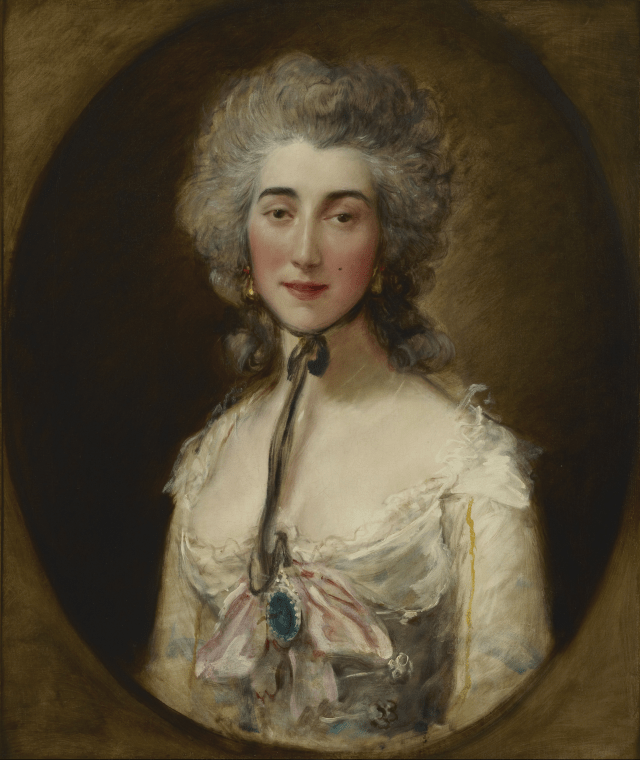
Grace Dalrymple Elliot (c.1778)
Oil on canvas (76 x 63 cm)
The Frick Collection, New York
To enlarge the image, right-click on it and “Open in a new tab”
It is very difficult to do justice to Gainsborough’s portraits, sometimes it seems that there are not enough words in the English language to express our admiration when confronted with some of his most beautiful paintings. This is one of those cases, although I may just get away with it by using the cliché: “This is one of Gainsborough’s finest works” and it really is. In fact, Gainsborough painted two portraits of Grace Elliot: this one and the magnificent full-length at the Metropolitan Museum of Art in New York. Both are stunning works of art. The full-length reminds us of the grand portraits by van Dyck, Gainsborough’s favourite painter, whereas the one in the Frick Collection is pure Gainsborough. On a close inspection, it looks like an oil sketch; fresh, light brushstrokes seemingly without purpose, pure colour and light, and then, when we step back and look properly at it, the full beauty of the painting, and the sitter, is revealed.
Grace Dalrymple was born in 1754, at the age of seventeen she was introduced to Edinburgh’s society; her beauty made such an impression on Dr John Elliot, a prominent and wealthy physician, that he proposed to her. Although Elliot was 20 years her senior, Grace’s parents did not oppose the marriage. As it was to be expected they grew apart due to their difference in age and interests. Grace met and fell in love with, Lord Valentia. Her husband, who was suspicious, had the lovers followed. He eventually sued Valentia for adultery and obtained a divorce. Grace’s reputation was ruined and became a courtesan (a polite word to describe a professional mistress)
She met Lord Cholmondeley in 1776 and began an affair that would last three years. In 1782 she had a brief affair with the Prince of Wales, in March 1782 she gave birth to a girl, according to Grace the Prince of Wales was the father, apparently, he admitted his responsibility but it was Lord Cholmondeley who took care of the child and brought her up. In 1784 the Prince of Wales introduced her to Louis Philip II Duke of Orléans; she became his mistress and by 1786 she was living in Paris in a house provided by the Duke.
When the French Revolution broke up Grace Elliot’s house became a haven for persecuted aristocrats. She not only hid them but provided them with papers to enable them to leave the country. She also acted as a contact between the British government and the French exiles in Coblenz. In 1793 she was arrested, but they could not prove anything against her. Miraculously she survived the Terror and was released at the end of it. Grace remained in France for the rest of her life, where she died in 1823 aged 69.
Incidentally, Grace’s love affair with the Duke of Orléans inspired a French film titled “L’Anglaise et le duc” (The English Woman and the Duke); the British version’s title is “The Lady and the Duke”, directed by Eric Rohmer (2001). The film is rather slow and tedious but interesting for those who like period dramas and, in my opinion, gives an accurate picture of what unscrupulous and ambitious coward Louis Philippe II, known as “Philippe Egalité”, was.
 Old Masters