
GEORGES DE LA TOUR (1593-1652)
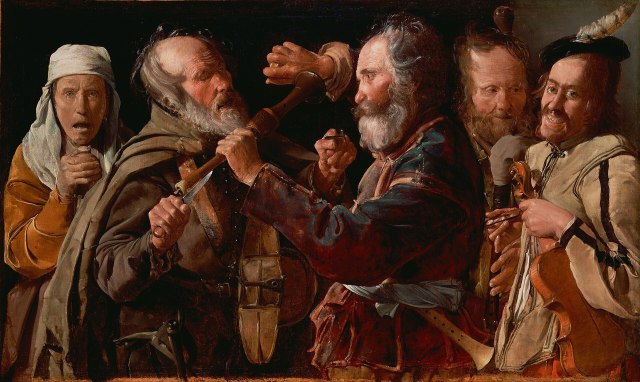
The Musicians’ Brawl (c. 1625-30)
Oil on canvas (86 x 141 cm)
Paul Getty Museum, Los Angeles
To enlarge the picture, right-click on it and “Open in a new tab”
Born in Lorraine, a place where the Nordic, French and Italian cultures meet; a contemporary of Jacques Callot (1592-1635) and the brothers Le Nain, Georges de La Tour was a profound observer of everyday life and a man of a deep religious sensitivity. Fascinated by the effects of lights and shadows he became one of the most original French followers of Caravaggio. About his first years, very little is known, he was from humble origins, his parents were bakers in the village of Vic-sur-Seille. As a painter, he seems to have been self-taught. It has been suggested that he may have travelled to the Netherlands in 1616 where he had the opportunity of seeing the work of Hendrik ter Brugghen and Gerrit Honthorst, but there is no documentary evidence of this.
In July 1617 he married Diane Le Nerf, a member of a noble family from Luneville. The couple moved there and La Tour began a brilliant career as a court painter to Henri II of Lorraine, a great admirer of Caravaggio. It was there that he definitely must have seen works by the French and Dutch followers of Caravaggio. In 1619 he moved into the Chateau de Luneville, the residence of Henri II and in the next year, the sovereign awarded him the privilege of not paying taxes, a prerogative of the nobility. De La Tour became a wealthy man and could devote himself entirely to his craft. There was a particularly great demand for religious paintings, and the wealthy bourgeoisie and the nobility vied to own a painting by de La Tour.
By 1633 the clouds of war began to gather over Lorraine, ruled by the inept Duke Charles IV. In 1638 Luneville was taken and burned, de La Tour like many others had already abandoned the city, in his case going to Nancy where he would remain until 1639. By late 1639 he was in Paris where he was well received by Louis XIII who appointed him peintre ordinaire du Roi (painter to the King) the position included lodgings at the Palace of the Louvre. In 1641 he is back in Luneville where he recovers his old privileges as a painter and a citizen. The last years of his life were dedicated to religious paintings, either due to a personal sentiment or because of the great demand for religious images after the Thirty Years War.
The subject of The Beggars’ Brawl is the fight of two elderly itinerant musicians over a place to play their instruments. The man on the left, with a hurdy-gurdy, slung over his shoulders is defending himself with a knife and the crank of his instrument. He is menaced by another man who seems to be hitting him with a kind of oboe. The second man squeezes the juice of a lemon into his opponent’s eyes, either to test if he is really blind or simply to further irritate him. On the left, there is an old woman begging someone to help. At the right, two more beggars, one with a violin and the other with a bagpipe, enjoy the fight.
 Old Masters