
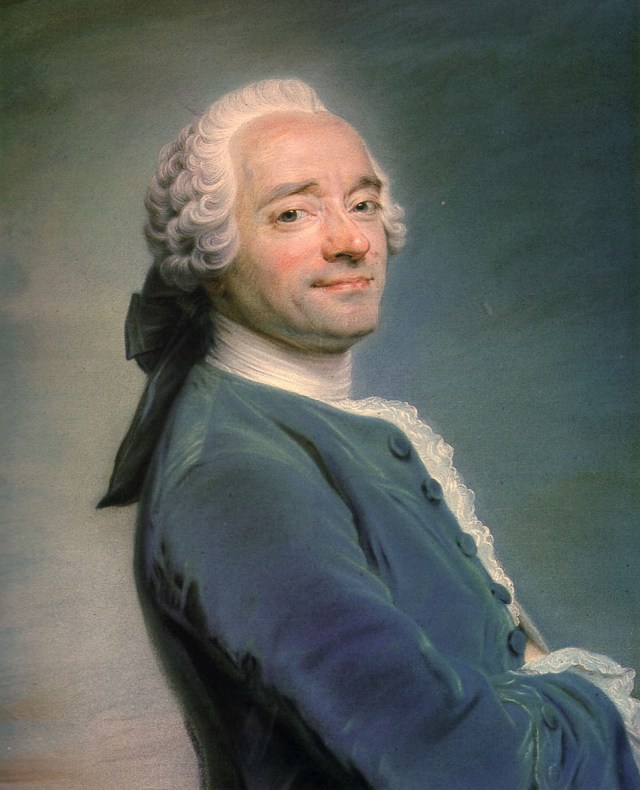
MAURICE QUENTIN DE LA TOUR (1704-1788)
Self-portrait (1751)
Pastel on paper
Amiens, Musee de Picardie
To enlarge the picture, right-click on it and “Open in a new tab”
Maurice Quentin de La Tour showed at a very early age outstanding aptitudes for drawing. At the age of 18, having decided to become an artist, he left his hometown of Saint-Quentin for Reims where he looked for a master. He ended up in Paris where he joined the atelier of Claude Dupouch, a member of the prestigious Academy of Saint Luke, in 1719. In 1725 he moved to Cambrai where the congress to put an end to the War of the Spanish Succession was taking place. He carried out several portraits of the diplomats gathered there; among them, his portrait of the Spanish ambassador was singled-out as a particularly excellent likeness that caught the eye of the British ambassador, Horace Walpole who invited the young artist to England.
Thanks to Walpole who introduced him to his acquaintances de La Tour was able to portray numerous members of the upper classes, wealthy entrepreneurs, noblemen, and fashionable ladies. His portraits were widely acclaimed and engraved by the most important British artists. After two very productive years, de La Tour decided to return to France (1725) where he expected to repeat the success that he had enjoyed in England. Anxious about getting access to the important artistic circles he visited the foremost portrait painters of the day; Rigaud treated him coldly but Largilliere was very gracious and became a friend, an advisor and a mentor. The painter Jean Restout introduced him to the most famous painters of the moment: Carle van Loo, Vernet, Parrocel, Greuze, and Lemoine.
When shown de La Tour’s paintings Louis de Boullogne premier peintre du Roi said: “You do not know yet how to paint or draw, but you have a talent that may take you very far” and he advised the young artist to concentrate in the drawing. De La Tour would spend two years (1727-1729) practising only drawing and painting in pastels achieving in this medium a unique skill. In 1735 his portrait of Voltaire was lauded by the critics and the public. On 25 May 1737, he was made an associate of the Royal Academy and in September of the same year, he exhibited the grandiose full-length Portrait of the President de Rieux (Los Angeles, Paul Getty Museum). In September 1746 he became a member of the Royal Academy, by that time he had also become the portraitist of the royal family.
Painted in 1751 this is, in my opinion, the finest of all de La Tour’s self-portraits, he looks at the viewer with a smile that indicates a happy individual, conscious of his position in society and very pleased with himself. His superb technique is clearly evident when we look at the tones of the flesh, the soft texture of his velvet coat and the highlights in his cravat. The only artist that came close to him as a pastellist was his rival Jean-Baptiste Perronneau (1715-1783) a superb painter in his own right.
 Old Masters