
JEAN-FRANCOIS DE TROY (1679-1752)
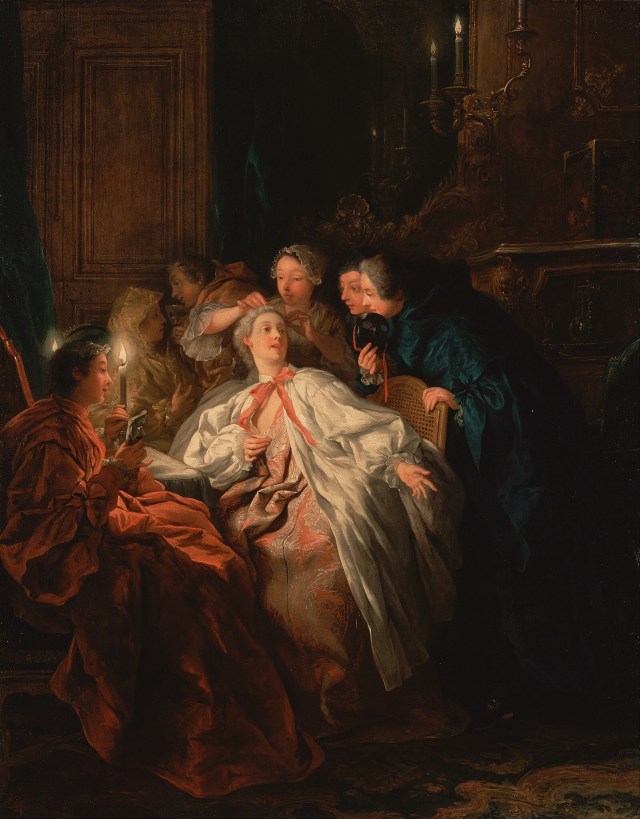
Before the Ball (1735)
Oil on canvas (82 x 63 cm)
Paul Getty Museum, Los Angeles
To enlarge the picture, right-click on it and “Open in a new tab”
De Troy was a very talented and versatile artist; he was an equally competent draughtsman, easel and fresco painter and tapestry designer. One of France’s leading history painters, he was equally successful with his decorative paintings, genre scenes and portraits. He was the creator of the tableaux de mode (pictures of fashion or, more accurately, manners) which provide a lively portrayal of contemporary fashions, pastimes and manners. He worked successfully on both large and small scale, and his works, like those of Watteau (1684-1721) vividly convey the elegance and sophistication characteristic of the fashionable Parisian society of the time.
The museum’s painting, along with its companion piece, The Return from the Ball (now lost, but known from an engraving), was painted in 1735 for Germain-Louis de Chauvelin minister of Foreign Affairs and Keeper of the Seal under Louis XV. When De Troy exhibited them in the Salon of 1737, the pair was declared to be the artist’s finest work.
Before the Ball typifies De Troy’s tableaux de mode, colourful depictions of the aristocratic society at home and at leisure. These paintings are considered to be amongst the most significant of the artist’s works. In the museum’s painting, a group of men and women watch a maid put the final touches on her mistress’s hair. The onlookers are already wrapped in their cloaks and hold masks in eager anticipation of the evening’s festivities.
At the time, some critics disapproved of the frivolous lifestyle celebrated by such paintings, but De Troy apparently moved easily in fashionable circles and does not appear to have been moralizing about the vanity of the aristocratic behaviour, On the contrary, he seems to have relished it and to have well understood its nuances and conventions. He has succeeded in capturing the slightly charged and merry climate of the proceedings, and there is a certain realism in his observation that betokens a sharp perceptive eye.
De Troy was ennobled twice in his lifetime, the first time when he bought the title of secretaire du Roi (Secretary to the King) and the second time on the award of the Order of St. Michael. In 1738 he left France for Rome following his appointment as Director of the French Academy in Rome. He remained in Rome for the rest of his life. He was also elected as an honorary member of the Roman Academy of Saint Luke. Although his professional career was a very successful one, his private life was marked by tragedy; his wife died at a young age as well as all of his seven children.
 Old Masters