
JEAN BAPTISTE GREUZE (1725-1805)
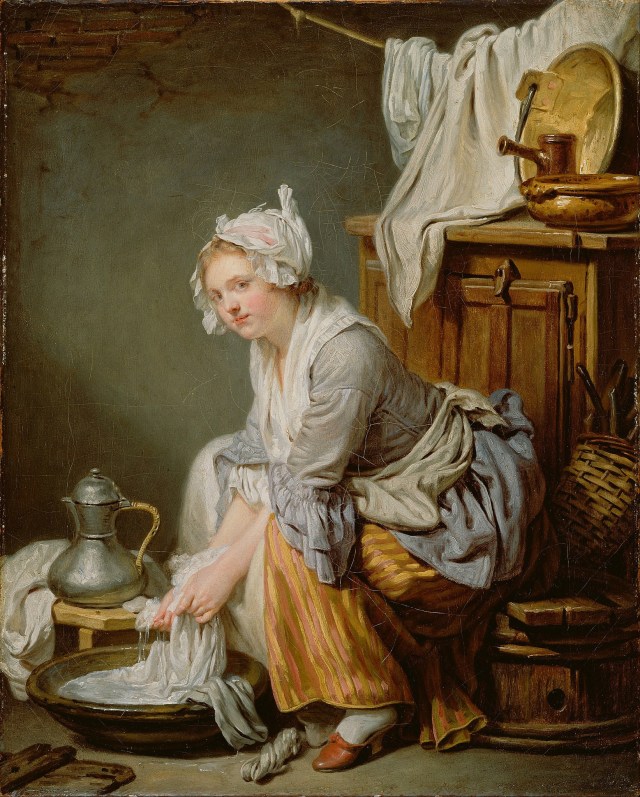
The Laundress (1761)
Oil on canvas (40.5 x 32 cm)
Paul Getty Museum, Los Angeles
To enlarge the picture, right-click on it and “Open in a new tab”
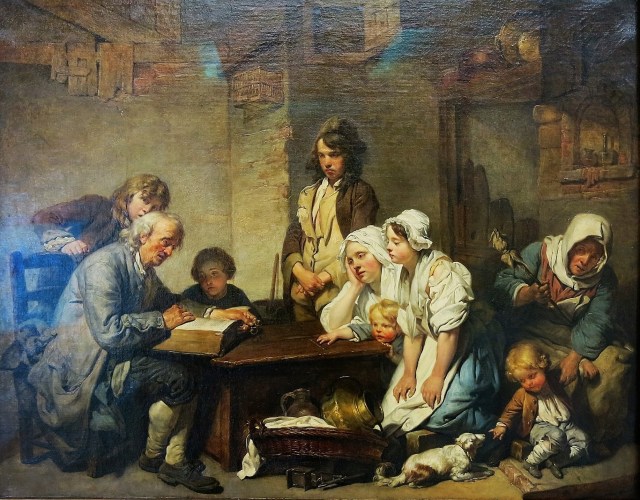
During the last half of the 18th century, Greuze was the most famous and successful exponent of genre painting in France. He normally chose themes with strong moralistic overtones, the closest parallels to which were to be found in the contemporary theatre rather than in the work of his fellow artists. At a time when academies extolled history painting as the highest form of art, Greuze attempted to raise his more mundane subject matter to a comparable level of importance. He first exhibited at the Salon of 1755 receiving great praise for his beautiful painting A Father Reading the Bible to his Children (Louvre Museum) The art critic Denis Diderot became one of Greuze’s admirers after they met in 1759. Diderot said that art had been for too long at the service of vice and decadence and Greuze’s works should be welcomed as they represented old virtues and values.
Like other French artists before him, Greuze was inspired by the study of the 17th-century Dutch and Flemish paintings that were extensively collected and admired in France during the 18th century. Many of his subjects are in fact taken directly from the works of Dutch and Flemish artists, who were the first to concentrate on depictions of working people and servants. In this case, The Laundress (1650) by Gabriel Metsu (Lazienki Palace, Poland) is a good example of the aforementioned
The Laundress was one of the 14 paintings that Greuze exhibited at the Salon of 1761. The painting was mostly unknown for more than two centuries, as it was purchased by Gustav Adolf Sperre in 1770 and remained in possession of the family until its purchase by the Getty Museum in 1983.
Modern critics, including the staff of the Getty Museum, have given The Laundress an erotic overtone that is ludicrous and only shows their ignorance about Greuze’s character and disposition. They talk about “a provocative look in her eyes” which only exists in their imagination, and there is a ridiculous and spiteful mention of “her exposed ankle” when there is not such a thing. This is part of the sick nature of the contemporary art establishment which has been poisoned by Freudian theories obsessed with sex and perversity. That is one of the reasons for this blog. To fight against the malicious re-writing of Art History, the corruption of classical scholarship and the traditional values of Western art.
 Old Masters