
SIR JOSHUA REYNOLDS PRA (1723-1792)
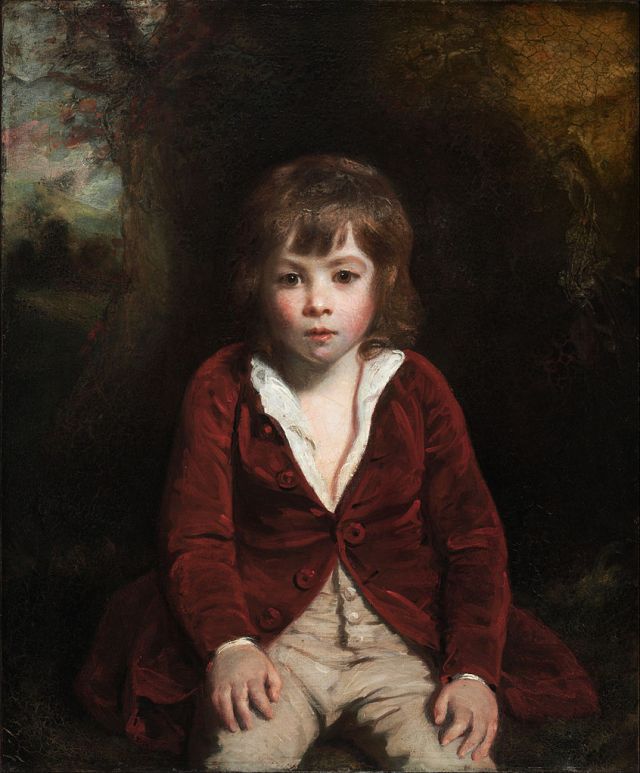
Master Bunbury (1780-81)
Oil on canvas (78 x 64 cm)
Philadelphia Museum of Art
To enlarge the picture, right-click on it and “Open in a new tab”
This is one of those paintings whose genesis and the behind-the-scenes story are as interesting as its aesthetical value. Scholars have disagreed over the identity of the little boy in this portrait. He was one of the two sons of Henry William Bunbury (1750-1811) the famous 18th–century caricaturist and Catherine Hornbeck (1753-1798) whom Oliver Goldsmith nicknamed “Little Comedy” because she was said to resemble the figure of Comedy in Reynolds’s Garrick between Tragedy and Comedy (England, private collection). However, John Chaloner Smith correctly identified him as their younger son, Henry Edward Bunbury (1778-1860) who in 1821 succeeded his uncle Thomas Charles Bunbury, 6th Baronet (1740-1821), as the 7th Baronet.
In 1830 Henry married his second wife, Lady Emily Napier, to whom he was distantly related through her mother, Lady Sarah Lennox Napier, the woman who, married to her first husband, Sir Thomas Bunbury (Henry’s uncle) had been painted by Reynolds in his famous canvas Lady Sarah Bunbury Sacrificing to the Graces (Art Institute of Chicago). Henry Bunbury was a distinguished officer, Under Secretary for War from 1809 to 1816, lieutenant-general in 1830, and for many years Member of Parliament for Suffolk.
Reynolds was an old friend of both the Bunbury family and Catherine Hornbeck. According to family tradition, Sir Joshua actually proposed to her, and true or not, he remained devoted to her throughout his life. This picture of her child he painted for himself, keeping it in his house during his lifetime and bequeathing it to her in his will. The reason for this is straightforward, according to William T. Whitley (Artists and Their Friends in England, 1700-1799), Henry was Sir Joshua’s godson.
Assuming that the portrait was painted in the months preceding the Royal Academy exhibition of 1781, Henry is nearly three years old here. He sits on a knoll in a wood, dressed in an open shirt and a wine-coloured jacket, staring straight at us. His open-mouthed, wide-eyed concentration and his slightly anxious expression can be explained by the fact that Sir Joshua kept him still by telling him spellbinding fairy tales during the sittings. Horace Walpole called the picture “charming” and The Morning Chronicle thought it a portrait “which to uncommon force unites the characteristic simplicity of childhood in a high degree” The pose is simple and straightforward, for although Reynolds first used this full-frontal, three-quarter-length format in his Nelly O’Brien of 1760-62 (London, Wallace Collection) he seems to have preferred it for portraits of children, for example, Master Crewe as Henry VIII (London, Marquis of Crewe) and Lady Caroline Scott as Winter (London, Duke of Buccleuch and Queensberry Collection).
 Old Masters