
ANTON VAN DYCK (1599-1641)
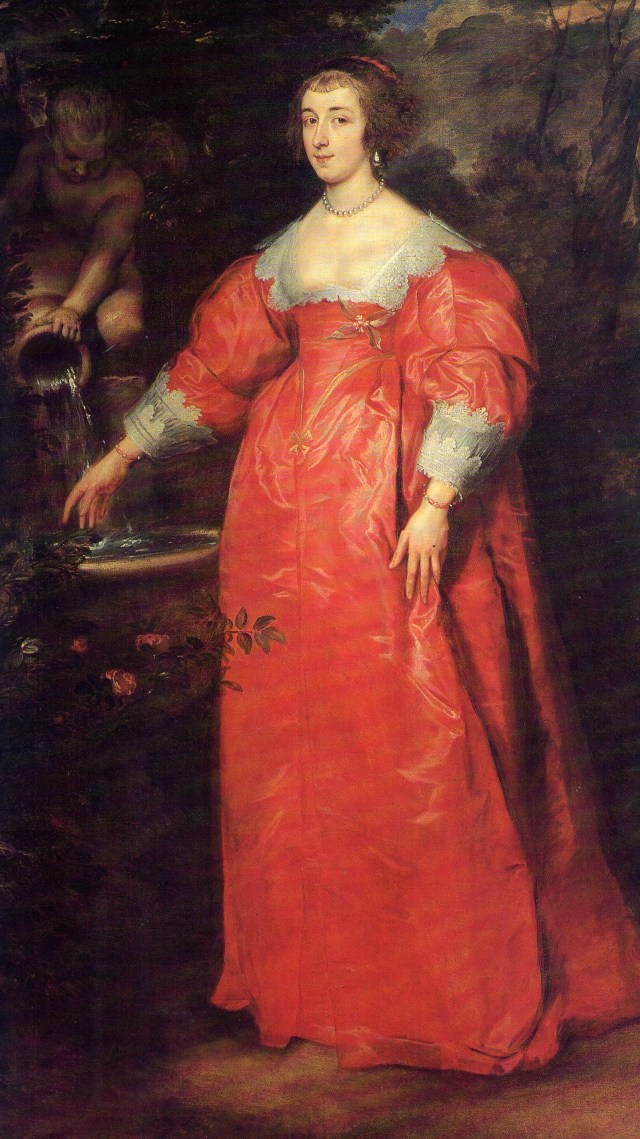
Portrait of a woman (c. 1634-35)
Oil on canvas (208 x 118 cm)
Windsor Castle, Royal Collection
Born in Antwerp, Anton van Dyck was a pupil of Rubens and as such he distinguished himself very early. An early visit to London in 1620-21 during the reign of James I was short-lived and the artist spent the next five or so years travelling extensively throughout Italy. These years were of the greatest significance for the development of van Dyck’s personal style; in fact, some of his finest early works were executed in Genoa where he perfected his idea of portraiture in the Grand Manner.
In 1632 he returned to England where he was appointed court painter to Charles I and Henrietta Maria. Apart from a short visit to Brussels in 1634-5 and brief visits to Antwerp and Paris in 1640-1, van Dyck remained in London, living in Blackfriars until his death. He was knighted in 1632 and received an annual salary from the King after 1633
Portrait of a Woman is a fine example of van Dyck’sfull-length portraiture. The sheen of the drapery, the intricacy of the lace, the care lavished on coiffure and jewellery, and the creamy flesh tones indicate the superb quality of van Dyck’s painterly approach. The setting serves to remind the viewer that the artist was also a superb landscape painter. On the basis of the coiffure, the portrait has been dated around 1634-5 and may have been painted in Brussels.
The iconography is of particular interest, and the artist seems to have introduced into portraiture the motif of the woman about to dip her hand into a fountain. He uses it for example, on two other occasions, Portrait of Marchesa Caterina Durazzo, c.1623 (Palazzo Reale, Genoa) and Portrait of Lucy Percy, Countess of Carlisle, c.1640 (Petworth, Earl Egremont). Originating in antiquity the motif passes through the Renaissance into the 17th century. The fountain refers to purity and chastity. The landscape setting suggests an enclosed garden that can be interpreted in the light of the medieval hortus conclusus (a Latin term meaning literally “enclosed garden”) According to the tradition hortus conclusus is both an emblematic attribute and a title of the Virgin Mary in medieval and Renaissance poetry and art. The term hortus conclusus is derived from the Vulgate Bible’s Canticle of Canticles “Hortus conclusus soror mea, sponsa, hortus conclusus, fons signatus” (An enclosed garden is my sister, my spouse, an enclosed garden, a fountain sealed up) Christian tradition states that Jesus was conceived to Mary miraculously, without disrupting her virginity, by the Holy Spirit. As such Mary in late medieval and Renaissance art was shown in an enclosed garden. This was a representation of her “closed-off” womb, which was going to remain untouched, and also of her being protected, as by a wall, from sin. However, because Cupid in this instance forms part of the fountain’s design and a rose bush grows nearby, the scene implies that this is a garden of love in which the sitter appears as a love-inspiring yet chaste presence. Similar compliments to women can be found in 17th-century poetry. Such motifs were also later used by Reynolds and Gainsborough. Of these two artists is Gainsborough who showed a greater kinship with the present portrait.
 Old Masters