
WILLIAM HOGARTH (1697-1764)
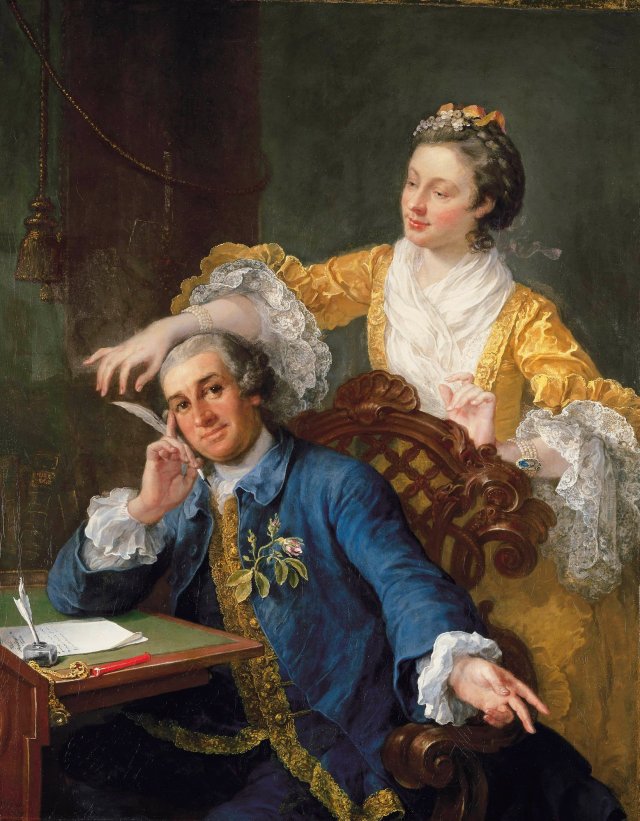
David Garrick with his Wife Eva-Maria Veigel (c. 1757)
Oil on canvas (133 x 104 cm)
Windsor Castle, Royal Collection
To enlarge the image, right-click on it and “Open in a new tab”
The portrait was presumably a personal commission from the actor David Garrick. It was reported to be in progress by 1757: “Hogarth has got again into portraits and has his hands full of business and at a high price. He has almost finished a most noble one of our sprightly friend David Garrick and his Wife; they are a fine contrast.” (letter from John Hoadly to Joseph Warton on 21 April 1757).
Even though Garrick paid the artist in full in 1763, the painting was still in the artist’s studio on his death a year later. Tradition has it that a difference of opinion arose between Hogarth and Garrick (a notoriously proud and vain man) over the likeness, and it is apparent that the artist had some difficulty with the eyes, where there are signs of erasure, particularly to the left eye. The X-ray evidence reveals that Hogarth had more profound difficulties with the composition. The background was originally a domestic interior with a bookcase and mirror, but these seem to have been overpainted and the figure of Garrick’s wife altered.
The composition is based on a pyramid but the use of diagonals fuses the two figures together, although Garrick’s pose looks staged and melodramatic, his wife’s pose looks natural. Hogarth has depicted Garrick’s wife, the Viennese dancer Eva-Maria Veigel (1725-1822), known as Violetti, in a coquettish pose which could be seen as either inspiring or distracting the great actor from his work composing a prologue to a satire on connoisseurship. Garrick is wearing a violet on his buttonhole, a flower that symbolizes everlasting love.
I consider this painting a very mediocre one, mainly because of Garrick’s ridiculous pose and expression. Ironically, the great actor looks like someone trying very hard to act in a casual manner; no wonder Garrick refused to accept the picture which remained in Hogarth’s studio. After the artist passed away, his widow generously gave it to Mrs. Garrick. On June 23, 1823 Christie’s auctioned Mrs. Garrick’s pictures and memorabilia and the double portrait was bought by Capt. E. H. Locker who later sold it to George IV. , According to Charles Lewis Hind (1862-1927), author of a little biography of Hogarth (1910), Capt. Locker’s son wrote in his “Memoirs” “This picture is so lifelike that as little children we were afraid of it; so much so that my mother persuaded my father to sell it to George IV.”
Garrick was arguably the most versatile actor of the 18th century, responsible for a radical change in the style of acting and particularly noted for his performances in the tragedies of Shakespeare. The political philosopher Edmund Burke remarked that Garrick “raised the character of his profession to the rank of a liberal art”. His greatest performance was perhaps as the King in Richard III, first given in 1741, which inspired Hogarth’s large painting now in the Walker Art Gallery in Liverpool. On the other hand, Garrick irritated many of his acquaintances with his vanity and superficiality; Oliver Goldsmith characterized him brilliantly in his poem “Retaliation”
 Old Masters