
REMBRANDT VAN RIJN (1606-1669)
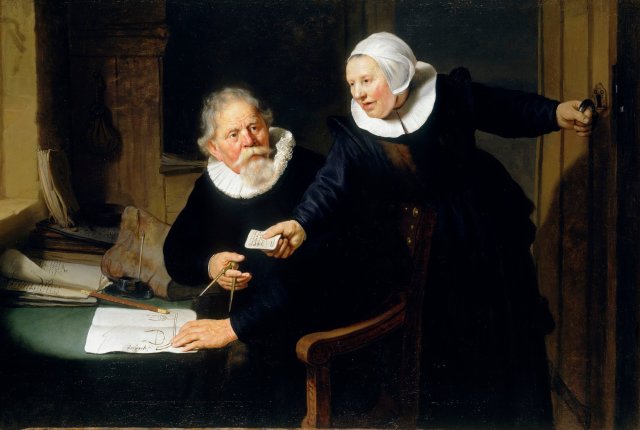
Jan Rijcken and his Wife, Griet Jans / The shipbuilder and his Wife (1633)
Oil on canvas (114 x 169 cm)
Buckingham Palace, Royal Collection
To enlarge the images, right-click on them and “Open in a new tab”
The Shipbuilder and his Wife is a painting of the greatest significance, both in terms of Rembrandt’s development and the history of the Royal Collection. The artist painted relatively few double portraits, and of the other three in his oeuvre Cornelis Claesz. Anslo in Conversation with a Woman (Berlin-Dalhem, Gemaldegalerie) is the closest in composition and treatment.
The present painting dates from Rembrandt’s early maturity, shortly after he moved from Leiden to base himself in Amsterdam, where The Anatomy Lesson of Dr Tulp (The Hague, Mauritshuis) of 1634 helped to establish his reputation. In The Shipbuilder and his Wife, the artist has transformed the Renaissance treatment of the double portrait, which had become staid in the hands of Rembrandt’s predecessors, into the vigorous Baroque style. In the 17th century, married couples were usually shown as two separate portraits, with the husband hung to the left (as we look at it, that is on the wife’s right hand), often with some gestures or glances linking the two. The focus of the painting is the letter, which units the action of both figures. The strong diagonal created by the outstretched arm of Griet Jans is countered by the direction of the light coming from the window on the left.
In this work, Rembrandt has in fact combined portraiture with genre, creating for himself the opportunity to portray greater insight into the character and thus to elevate portraiture to a level of higher psychological interest. This means that the figures overlap and their interaction is more vivid: we are to imagine that Griet Jans has burst into the room (her hand still on the door), interrupting her husband with a message which seems to her of the utmost urgency. Everything about her expresses anxiety. Jan Rijcken does not seem excited at all; in fact, he looks slightly irritated by the interruption.
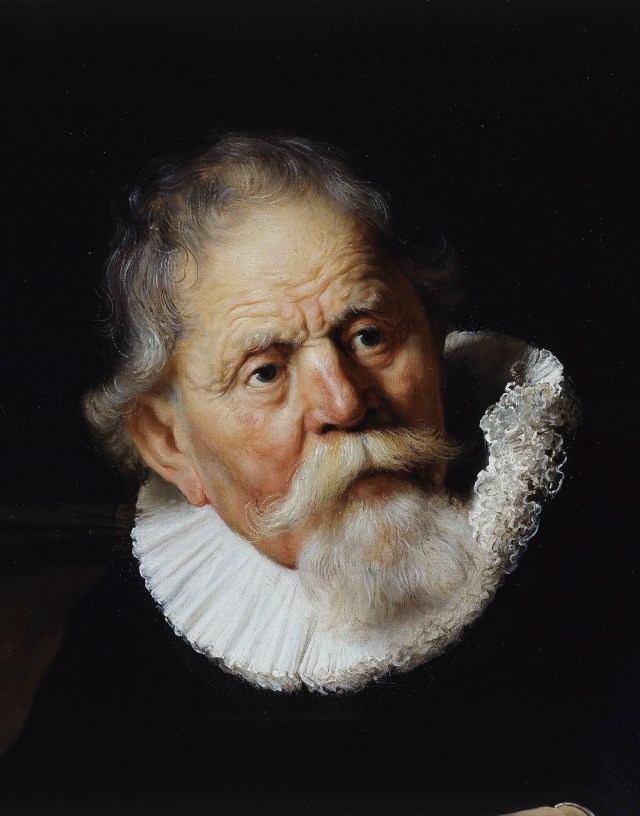
Rembrandt uses the soft light to bring out the facial features of the elderly couple. The flesh tones betray a more open, supple style of brushwork. Several layers of paint, for example, have been used to build up the surface to suggest the texture of wrinkled skin. This picture belongs to a time when Rembrandt was a highly successful and fashionable portrait painter. His art was also at its most naturalistic, especially in the depiction of textures and surfaces, which are here described in great fidelity, neither glossing over nor revelling in the leathery, weather-beaten skin and white hair of his elderly sitters. This close-up image of Jan Rijcken’s face perfectly illustrates the aforesaid and Rembrandt’s marvellous skill.
The Shipbuilder and his Wife was George IV’s most spectacular purchase in the field of Dutch painting. At the beginning of the 19th century, the painting belonged to the famous Dutch collector Jan Gildermeester, and it was subsequently acquired in 1811 by George IV for 5.000 guineas (1), a staggering sum of money for those days, and easily the highest price he paid for a painting. The picture was initially hung in the Blue Velvet room in Carlton House, where George IV lived until he had the palace demolished in 1827.
(1) A guinea was worth 1 pound and 1 shilling; in modern British currency, 5.000 guineas would be the equivalent of £5.250. Those 5.000 guineas of 1811 today would be worth £5.303.000.
 Old Masters