
NATHANIEL DANCE (1735-1811)
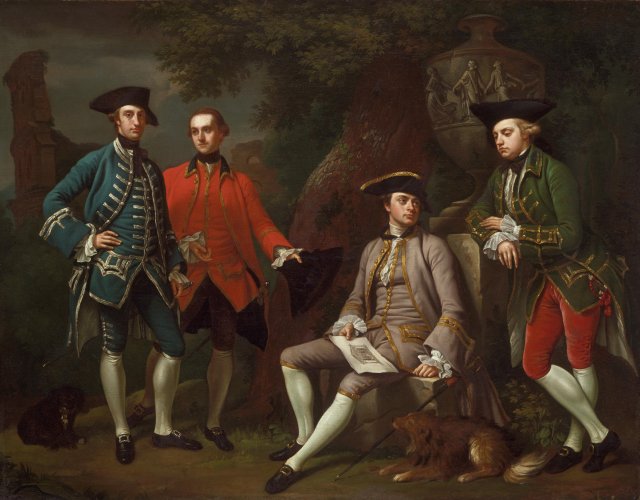
A Conversation Piece: James Grant of Grant, John Mytton, The Hon. Thomas Robinson, and Thomas Wynn (1760-61)
Oil on canvas (96 x 123 cm)
Philadelphia Museum of Art
To enlarge the picture, right-click on it and “Open in a new tab”
Nathaniel Dance’s career resemble that of other British artists of that period; although he tried his hand at historical subjects he soon found that British art collectors were not interested in that kind of painting and he dedicated himself to portraiture where he achieved considerable success. He also produced some group portraits known as “conversation pieces” but they are rather mediocre. Although I consider this particular group portrait a poor example of Dance’s artistic skill, I decided to include this painting in the blog for its historical significance. The picture portrays four British gentlemen supposedly discussing Roman art and architecture; at least those were the reasons for their presence in Rome during their Grand Tour. The importance of the Grand Tour in the British cultural scene of the 18th century and early 19th century cannot be emphasized enough. It was men like these portrayed here that turned the English countryside into a series of beautiful gardens dominated by splendid mansions. Without their interest in, and love of, Classical art and architecture and Italian art, Great Britain’s artistic heritage would be fairly poor.
This picture is one of four almost identical canvases painted between 1760 and 1761 for each of the four sitters. They are, from left to right, James Grant of Grant (1738-1811); John Mynton (d.1784); the Hon. Thomas Robinson (1738-1780) and Thomas Wynn (1736-1807). They are shown in an imaginary landscape, with the ruins of the Colosseum behind them on the left, and a large classical urn decorated with dancing female figures on the right. The task of painting copies was a disagreeable one for most artists and Nathaniel Dance was no exception, as he made it very clear in a letter written on December 17, 1760:
“I have not yet quite freed myself from the disagreeable task of copying the Conversation Picture, tho’ I believe it will now not be long before I shall. It has taken me a good deal of time, as I was obliged to make 4 copys… Yet I could not refuse to doing it, as it was a means to make me acquainted with my Lord Grey and the other gentlemen who have given me commissions for other pictures. Besides, it was done on the footing of friendship, & I am convinced that these gentlemen will do me all the service that lyes in their power. I hear already that Mr. Robinson has recommended me to the Duke of Marlborough” (David Sellin: Philadelphia Museum of Art Bulletin, Vol. 56, No. 268 (1961) p. 61-63)
Dance’s artistic limitations are quite evident when we look at the awkward disposition of the four men. To begin with, James Grant is rudely ignoring poor John Mytton; Thomas Robinson, who looks very tired (or bored) is showing a print to Thomas Wynn who does not seem interested at all, in fact, he is not even looking at the print. Now, let’s focus on the print which is the centre of attention; it shows an elevation of the temple of Jupiter Stator. The fact that the men should be discussing this particular building is hardly fortuitous since its columns were in the process of being restored the year the portraits were painted. Nathaniel’s younger brother, the architect George Dance the Younger, mentioned this to his father in a letter dated October 4, 1760: “The three famous columns of the Temple of Jupiter in the Campo Vacino, being in a very ruinous condition, the Campidoglio have employed Workmen to repair and preserve them, to perform which they have raised a Scaffold quite up to the Architrave”
Thomas Robinson was a keen amateur architect and later a member of the Society of Dilettanti (elected in 1763) as were Mytton (elected in 1764) and Wynn (elected in 1764) but we do not know if they availed themselves of the opportunity to climb the scaffolding. Although two of the poses distantly echo famous classical statues – the Apollo Belvedere pose struck by Mytton and a rather drowsy Hercules Farnese by Wynn – Dance has used Antiquity as a prop and backdrop against which he has placed his visiting English gentlemen. Far from responding to Antiquity with the passionate moral earnestness of Reynolds, Dance and his patrons trivialize the classical past. Still, the picture is an important document of the Grand Tour, serving, as it might, to symbolize generations of 18th-century British travellers to Rome.
 Old Masters