
THOMAS GAINSBOROUGH (1727-1788)
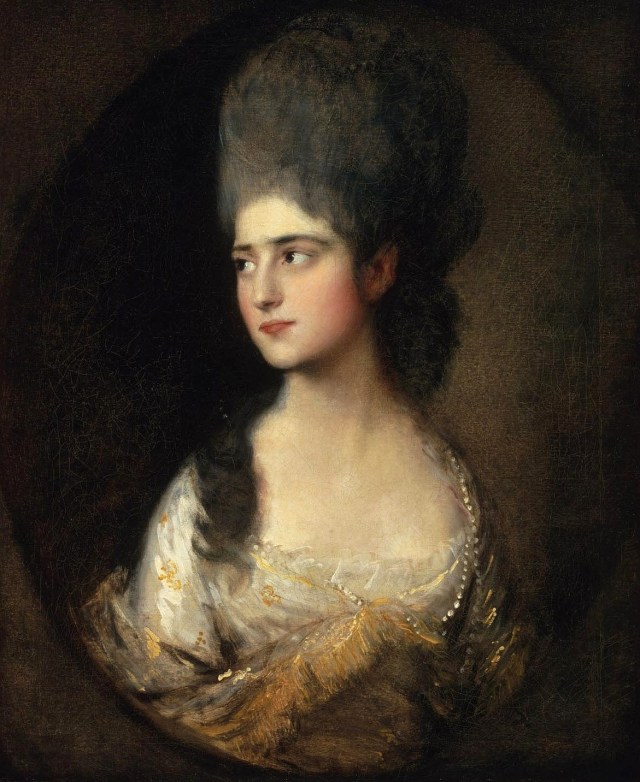
Miss Elizabeth Linley, later Mrs Richard Brinsley Sheridan (1775)
Oil on canvas (76 x 63 cm)
Philadelphia Museum of Art
“She is really beautiful, her complexion a clear, lovely, animated brown, with a blooming colour on her cheeks; her nose, that most elegant of shapes. Grecian, fine luxurious, easy-sitting hair, a charming forehead, pretty mouth and most bewitching eyes. With all this, her carriage is modest and unassuming, and her countenance indicates diffidence, and a strong desire to please. a desire in which she never can be disappointed” (1) So Fanny Burney described the sitter in this portrait in her diary for April 1773. That she should have been curious to meet the beautiful Mrs Sheridan is not hard to understand: she was meeting not only the most celebrated English soprano of her day but a woman who, in her private life, had staged one of the most romantic elopements of the 18th century with a man who was to become famous both as a playwright and as a politician: Richard Brinsley Sheridan (1751-1816).
There are many contemporary descriptions of the quality of Elizabeth’s voice, but none more eloquent than that of Gainsborough’s friend William Jackson: ” Her voice… was remarkably sweet and her scale just and perfect… Her genius and sense gave a consequence to her performance which no fool with the voice of an angel could ever attain and to these qualifications was added the most beautiful person expressive of the soul within” (2)
Gainsborough must have known Eliza as a child in Bath, for the artist’s circle of friends always included composers and musicians. In his biography of Gainsborough, Thicknesse tells a story that conveys the spontaneity of the painter’s enchantment with the young Eliza: “After returning from the Concert at Bath, near twenty years ago, where we had been charmed by Miss Linley’s voice. I went home to supper with my friend, who sent a servant for a bit of clay, with which he first modelled, and then coloured her head, and that too in a quarter of an hour, in such a manner that I protested it appeared to me even superior to his paintings!” (3)
Gainsborough painted her several times, both before and after her marriage – most spectacularly in two full-length portraits, one from 1772 at Dulwich College Picture Gallery, the other from 1785-87 in the National Gallery of Art in Washington DC. In the earlier picture, she stands to the left of her sister Mary who is seated by her side; the turn of Eliza’s head, her glance and even the arrangement of her hair is so close to the Philadelphia portrait that the latter could be described as simply a variation on the head in the Dulwich picture. The Philadelphia portrait can be dated c.1775 when Eliza was twenty-one years old, recently married and at the height of her fame and beauty. Sadly even at such early time, her marriage to Sheridan had begun to deteriorate. She endured with patience his long affair with the Duchess of Devonshire’s sister Harriet, Lady Duncannon. But then, in 1790 Eliza fell in love with a much younger man, Lord Edward Fitzgerald (1763-1798) By him she bore a child on March 30, 1792. She did not survive her confinement, dying of tuberculosis, after a reconciliation with Sheridan, on June 28, 1792
Thanks to Gainsborough’s genius Eliza lives forever in the hearts of genuine Art lovers and those who believe in the inspirational and ennobling power of Beauty
(1) Annie Raine Ellis (ed): The Early Diary of Frances Burney, 1768-1778 (London, 1889) Vol. 1, p. 203
(2) William Whitley: Gainsborough (1915) p. 201
(3) Philip Thicknesse: Memoirs and Anecdotes of Philip Thicknesse (1788) p. 39
 Old Masters