
POMPEO BATONI (1708-1787)
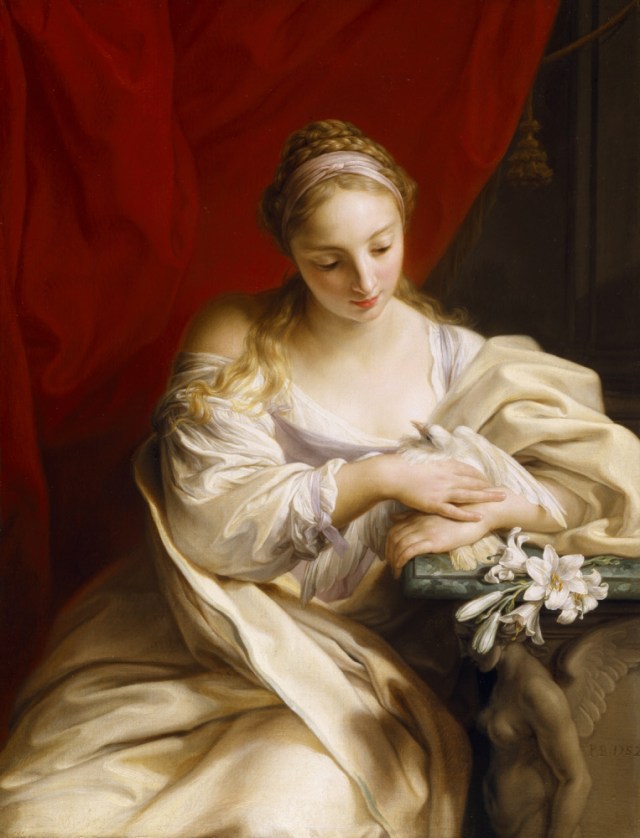
Purity of Heart (1752)
Meekness (1752)
Oil on canvas (98 x 74 cm)
Uppark, West Sussex, UK
To enlarge the images, right-click on them and “Open in a new tab”
The following paragraphs belong to Alastair Laing’s excellent book (1) published by the National Trust and the National Gallery for the magnificent exhibition held at the National Gallery from November 1995 to March 1996. The book’s exceptional quality is due to the extraordinary scholarship of Alastair Laing as well as to the beautiful reproductions that illustrate the handsome volume. Luckily, this superb catalogue was written before the great British institutions were taken over and completely corrupted by the hateful anti-European and anti-White ideology known as “political correctness” (an euphemism for cultural Marxism). Although this process has been going on for a long time, it was only after the death of a petty criminal (caused by a drug overdose) named George Floyd in 2020 that it became a tsunami that engulfed and destroyed everything beautiful and respectable. Nowadays is impossible to read an article, or watch a video, about European, and particularly British, art or history without reading or hearing vile and ridiculous references to slavery, colonialism, exploitation, genocide, etc., all of which were supposedly carried out, exclusively, by Europeans and, particularly, by the British. Having said this, let’s enjoy Mr. Laing’s essay (in italics):
“Since at least about 1815 these two pictures have always hung in the Saloon at Uppark, in the same register as the overdoor portraits of Sir Harry Fetherstonhaugh and his grandparents, Christopher and Sarah Lethieullier. As a result, they almost seem to take their place as additional members of the family. Perhaps for this reason, and because of the traditionally Anglican upbringing of the English, their unusual imagery was at first taken for granted, and then viewed in entirely secular terms as “Innocence” and “Love”
They, in fact, represent personifications of the second and fifth of the Beatitudes, from the Sermon on the Mount: “Blessed are the meek: for they shall inherit the earth… Blessed are the pure in heart: for they shall see God”. Further studies have demonstrated that these personifications were taken from Cesare Ripa’s Iconologia (1603): the young woman holding a lamb, signifying meekness or gentleness; and the other, clutching a dove to her heart, with lilies on the table (…) What does not seem to have been appreciated is how rare such painted depictions of Beatitudes were at any time (…) and how exceptional such single-figure personifications are in Batoni’s oeuvre, Nor how curiously they consort with Batoni’s portraits elsewhere in the house, particularly of Sir Matthew Fetherstonhaugh and his kin with various mythological attributes, of Adonis or Meleager, Diana, Apollo, Flora and the like
The explanation for this unusual commission is perhaps to be found in the composition of the Fetherstonhaugh party that sat to Batoni in 1751 while on their Grand Tour. In addition to Sir Matthew and his wife, it comprised her younger brother Benjamin and their older half-brother. But it also included Sir Matthew’s younger brother Utrick (…) Although there is nothing in his dress in Batoni’s portraits to indicate that Utrick was at this time in Holy Orders, he had already been ordained deacon in 1740 and priest in 1742. Therefore is logical to assume that it was Utrick who commissioned these beautiful paintings.”
The late Sir Michael Levey (1927-2008) singled out Purity of Heart as an embodiment of “Batoni’s style at his finest” but it is something more than that because, besides Batoni’s flawless technique and exquisite sensitivity, there is another dimension to these paintings and is how Batoni infused them with heartfelt piety.
(1) “In Trust for the Nation: Paintings from National Trust Houses” (1995) p. 148

 Old Masters