
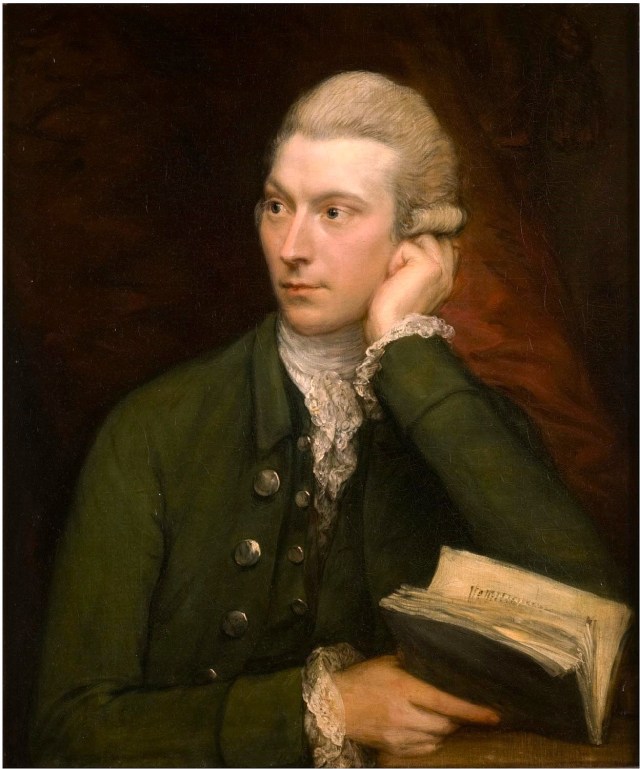
THOMAS GAINSBOROUGH (1727-1788)
Portrait of John Palmer (c.1775)
Oil on canvas 76 x 63,8 cm
Philadelphia Museum of Art
To enlarge the picture, right-click on it and “Open in a new tab”
John Palmer (1743-1818) is remembered in the history of the English stage as the manager of the Bath Theatre in Orchard Street, which, under him, attracted the greatest stars of the 18th-century stage. Among the performers who first appeared there were John Henderson, Mrs Siddons and Mrs Abington. But this is only the first phase in his remarkable career. In his work for the theatre, travelling up and down the country in search of actors, Palmer hit on a simple but brilliant idea for improving communications between English cities. Through his invention, he revolutionized the English mail service.
Before Palmer, the mail was carried in a one-horse diligence. If this arrived at all (robbery of mail was common) it was slow, taking two days to complete the journey between London and Bath. By suggesting that the mail be carried in a coach drawn by two horses, which were to be changed every six miles, he proposed to increase the speed of the mail to eight or nine miles an hour, thus cutting the London-Bath route to sixteen hours. Palmer’s coaches were to carry no passengers outside the coach and to be protected by shotgun-carrying guards.
In October 1782, Pitt’s government agreed to try Palmer’s plan. Within a few years, London was united to York, Chester, Glasgow and Liverpool by an efficient mail system, and by 1788, 320 towns that used to receive the post three times a week had it daily; an improvement that, if not quite similar to the invention of the telephone, was of vast importance for every aspect of English live.
Palmer knew very well the value of his invention. As a result of its success, he was appointed Comptroller General of the Post Office, in which capacity he proceeded to reorganize that department of the government. By oral agreement, he was to have received for life 2.5 percent of the increased revenue of the Post Office but the government failed to honour his promise. Palmer complained and he found himself dismissed from office, Eventually, in 1808, he won his claim for recompense, but by that time he had distinguished himself in other areas. He was twice elected mayor of Bath (in 1796 and 1809) and was returned as MP for the city four times (in 1801, 1802, 1806 and 1807)
Palmer himself is a fascinating figure. Born into an old Bath family he was educated for the church at Marlborough Grammar School, but instead, he entered the countinghouse of his father’s brewery, before devoting himself to the theatrical side of the family business. A hot-headed enthusiast, a man of great enterprise, perseverance and stamina he was a close friend of Gainsborough. The Philadelphia portrait shows him at about the age of 35 while he was still working in the theatrical business and before he became involved in the reform of the mail system. Gainsborough’s portrait suggests an intelligent, thoughtful young man.
 Old Masters