
PHILIPPE-LAURENT ROLAND (1746-1816)
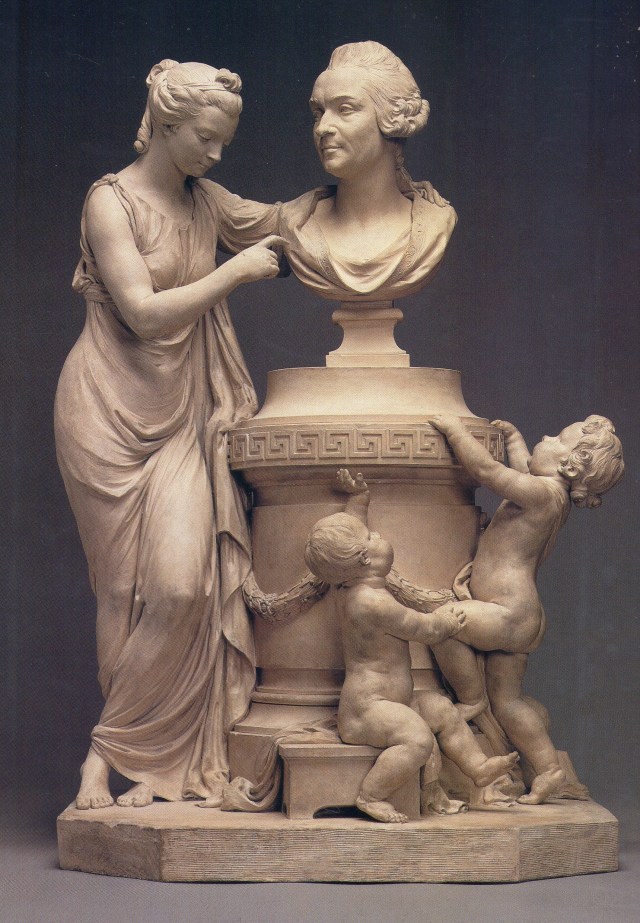
Allegorical Group with the Bust of an Architect (1780-90)
Terracotta: Height 67,3 cm
Paul J. Getty Museum, Los Angeles
To enlarge the picture, right-click on it and “Open in a new tab”
The son of a wood carver, Philippe-Laurent joined the atelier of the famous Agustin Pajou (1730-1809) at the age of eighteen. The master soon noticed the talent of the youngster and began to entrust him with more important commissions, including the decorations of the Palais-Royal in Paris and the Royal Opera at Versailles. His skill would eventually earn him the appointment of decorator and sculptor of the private rooms of Louis XVI and Marie-Antoinette at Versailles.
Between 1771 and 1776 Roland stayed in Rome, studying classical and modern sculpture, He did not enjoy the benefits of a scholarship. Since he was never interested in becoming an academician he did not apply for the Prix de Rome, the highly coveted prize that gave the winner a five-year stay in Rome under the supervision of the French Academy.
Upon his return from Rome, Roland rejoined Pajou’s workshop. His old teacher was greatly impressed by the quality of his work and made him his principal assistant. In 1777 Roland married Therese-Francoise Potain, daughter of Nicolas Potain, architect and director of the Batiments du Roi (1) this very fruitful relationship was enhanced by the marriage of Therese-Francoise’s sister, Marie-Adrienne to the architect Pierre Rousseau who was in charge of the building of the hotel de Salm (today Palace of the Legion of Honour) Thanks to his brother-in-law Roland received the commission to decorate the hotel. After the Revolution, Roland became a member of the Institut de France a body that replaced the Royal Academy of Painting and Sculpture. In 1809 he was appointed professor at the School of Fine Arts; position that he kept until he died in 1816
This group is built around the bust of a man placed on top of a pedestal in classical style. A young female figure has placed her left arm around the bust and is pointing at it with her right hand, showing it to two little children that resemble cherubs. One of them is trying to climb the pedestal, behind him there are some attributes of Architecture, the compass, the drawing square, books, a globe and sheets that represent drawings. It has been suggested that the group is a tribute to Pierre Rousseau, Roland’s brother-in-law, although there is no documental evidence to support this, that is why is simply considered as an allegory of Architecture.
(1) The literal translation is “The King’s Buildings”; however, this is misleading. The institution was responsible for the furnishing, restoration and maintenance of all royal residences, these duties included the supervision of the royal manufacturers of tapestries (Gobelins) and porcelain (Sèvres).
 Old Masters