
WILLIAM HOGARTH (1697-1764)
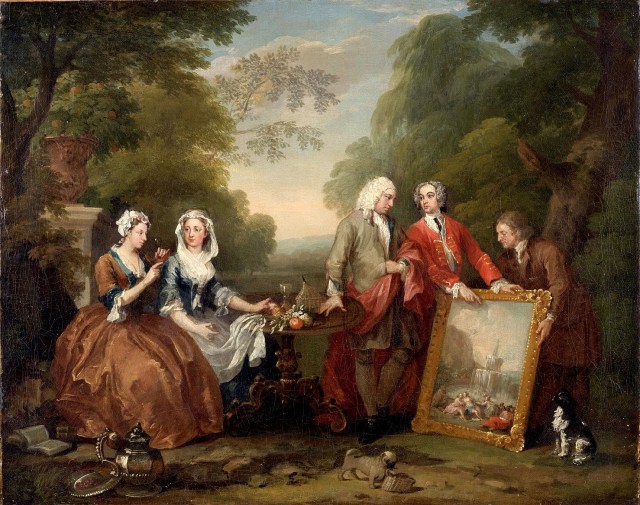
Conversation piece with Sir Andrew Fountaine (1730-35)
Oil on canvas 47,6 x 58 cm
Philadelphia Museum of Art
To enlarge the picture right-click on it and “Open in a new tab”
On the left are two young women sitting at a circular table, on which stand a wicker flask, some fruit and a glass. The woman on the left in a brown dress is looking through a magnifying glass at the painting the gentlemen on the right are discussing and pointing out its merits to her companion. At the other side of the table, to our right, three men are grouped around a picture. Gazing at the painting is an older man, his full-bottomed wig touching his shoulders, dressed in an 18th-century suit; he also wears a red mantle tucked into his left elbow and passed around his midriff – a device used in baroque portraiture to enhance the dignity of the sitter. The gentleman (Sir Andrew Fountaine) has placed his left hand within his buttoned coat, a dignified gesture underlying his position as the most important figure in the group. Next to him, a younger man wearing a short powdered wig and a red, embroidered coat, helps to support the picture with his left hand while pointing to it with his right. At the far right, supporting the carved and gilded frame is an older man in a plain brown suit
Sir Andrew Fountaine (1676-1753) came from an old Norfolk family. His father, also Andrew Fountaine (d.1706) purchased Narford Hall in 1666 and rebuilt the house in the Queen Anne style in 1704. His son was educated at Eton, then at Christ Chruch, Oxford, where he shone as the most brilliant classical scholar of the celebrated Dr Henry Aldrich (1647-1710). Andrew Fountaine was chosen to deliver an address of welcome in Latin to King William III, and for this reason, was knighted at the age of twenty-three. In the summer of 1701, he was sent to Hanover with Lord Macclesfield (1659-1701) to present the Electress Dowager Sophia with a copy of the Act of Succession. Upon his return from Germany, Fountaine began to advise the earls of Pembroke and Devonshire on matters of collecting, and in 1707 accompanied the Earl of Pembroke to Ireland as Usher of the Black Rod, where Fountaine met and patronized Jonathan Swift.
He succeeded to Narford Hall in 1706 and in 1708 he embarked on a stay in Paris, Rome and Florence. In the last city, he became a close friend of the Medici prince Cosimo III. By the time of his return to England in about 1717, Fountaine’s collection of coins, medals, majolica, watches and armour was unrivalled in England. Later he was to serve the Hanoverian royal family as vice-chamberlain to Princess Caroline; as a proxy for Prince William later Duke of Cumberland, at the prince’s installation at the revival of the Order of the Bath; and finally as Warden of the Mint (1727-53). His real claim to the attention of historians, however, is his incredible activity as a collector. To give an idea of how extensive Sir Andrew Fountaine´s collection was suffice to say that when most of it was auctioned off in 1884, the sale went on for four days. In 1894, Christie, Manson & Woods auctioned off 64 paintings from Narford Hall; the sale included works from Rubens, Rembrandt, Tintoretto, Tiepolo, Watteau and Poussin among many other famous masters and in June 1902 almost 1,000 books and manuscripts were sold from the hall’s extensive library.
Sir Andrew Fountaine died unmarried in Narford Hall in 1753 and was buried there. His Narford estate passed to his sister Elizabeth and later on to her grandson Brigg Price, who changed his surname to Fountaine and adopted his great-uncle’s arms. Narford Hall is still in possession of the Fountaine family and it is not open to the public.
 Old Masters